Why this matters
Build authority around missed calls, after-hours coverage, call overflow, and AI front desk workflows that turn calls into booked jobs.
Short Answer
For most owner-led landscaping companies, the best AI front desk is the one that turns inbound calls, missed calls, after-hours inquiries, and call overflow into booked work through one practical workflow: call answering, SMS follow-up, booking or scheduling handoff, owner controls, and review requests.
For that reason, the smartest buying path is usually category-first:
- Choose a workflow-linked AI front desk or AI receptionist if your main goal is turning more calls into scheduled jobs.
- Choose a hybrid AI + human answering model if you want broader edge-case coverage or are not ready to trust automation on every call.
- Choose a larger contact-center style platform only if you truly have enterprise routing or multi-queue volume.
From the currently reviewed source set, Sameday is one of the clearest home-service-specific examples, Smith.ai is a clear hybrid AI receptionist example, Goodcall is a configurable phone-platform example, and Avoca appears more aligned to higher-volume contact-center use cases. MyBusinessFlow belongs in the workflow-first evaluation lane for owner-led home service teams that want calls, SMS, booking, follow-up, owner controls, and reviews in one workflow, but the evidence reviewed here does not support naming any single vendor the default winner for every landscaping company.
If you are comparing AgentZap, Jobber, Housecall Pro, or ServiceTitan, do not settle for broad positioning claims. Verify how each option handles landscaping intake, urgency rules, booking depth, after-hours coverage, missed-call recovery, and owner approvals in the actual workflow you run every day. For broader context on AI call answering, missed-call recovery, and overflow workflows, start there; for a trade-specific view, see Landscaping.
Why landscaping companies need a different AI front desk comparison
Landscaping businesses do not just need a tool that answers the phone. They need a front desk workflow that can identify the job type, collect the right details, route urgency correctly, and move the customer toward booking or follow-up.
Landscaping intake is not generic
A landscaping inquiry can mean very different work:
- recurring maintenance
- one-time cleanup
- irrigation troubleshooting
- design-build or install estimates
- storm cleanup
- current-customer schedule changes
- billing, access, or service issues
A generic AI receptionist may answer politely, but that is not enough. A useful landscaping AI front desk needs to capture enough information to create a workable next step for the office, crew scheduler, or owner. That is the lens used throughout this comparison and throughout our broader AI answering coverage for home service teams.
Urgency handling matters even when you are not an emergency trade
Landscaping does not use the same urgency logic as HVAC or plumbing, but urgency still matters. Irrigation failures, storm damage, same-day commercial complaints, and safety-related hardscape issues should not be treated the same way as a routine quote request.
The best AI front desk for landscaping should know what gets escalated now, what gets routed to SMS follow-up, and what can wait until business hours.
The real goal is booked work, not just answered calls
The right buying question is not, “Which AI sounds the most natural?” It is, “Which AI receptionist helps us book more of the right work with less owner interruption?”
That is why response speed, qualification quality, booking depth, and follow-up matter more than surface-level demo polish.
How we evaluated the options
This comparison prioritizes revenue-critical workflow fit for landscaping teams:
- response speed
- qualification quality
- scheduling coverage
- urgency handling
- CRM or FSM fit
- operational leverage for the owner
The evidence reviewed here comes mainly from vendor and competitor materials rather than independent editorial testing, so the safest comparisons are based on documented positioning, stated integrations, and workflow fit. Pricing, setup effort, and automation depth were not consistently clear across sources and should be verified in demos.
What the best AI front desk for landscaping must do
Capture trade-specific intake details
A landscaping AI receptionist should reliably collect details such as:
- service address
- new or existing customer status
- service category
- urgency level
- preferred timing
- access notes
- follow-up by text, where supported
If the tool cannot capture landscaping-specific intake cleanly, your office still has to redo the work later.
Handle urgency without over-escalating
The right system should let you define what gets escalated, what gets scheduled, and what waits until business hours. That is especially important for:
- irrigation outages
- storm cleanup requests
- active account complaints
- same-day commercial issues
- schedule disruption for current customers
Continue into SMS, booking, or a clean handoff
A strong AI front desk should not stop at message capture. It should either:
- book directly,
- create a usable scheduling handoff, or
- trigger SMS follow-up so the lead does not go cold
If you care about call overflow and after-hours coverage, this is where the value shows up. More on that is covered in the AI answering hub.
Keep owner controls in place
Owner-led landscaping businesses usually need control over:
- business hours
- service area filters
- routing rules
- escalation rules
- approval logic
- when automation can book versus when it should ask first
Without those controls, an AI receptionist can create as much cleanup as it saves.
Connect reviews and follow-up to the same workflow
Many landscaping owners get better ROI when the front desk workflow does more than answer calls. The fastest gains often come when the same system supports:
- missed-call text-back
- estimate follow-up
- appointment confirmations
- post-job review requests
That is one reason many buyers should compare a broader workflow approach instead of only a standalone answering layer. For industry context, see Landscaping.
Best-fit recommendation by company type
Best fit for most owner-led landscaping teams: workflow-first AI front desk
For most owner-led landscaping businesses, the strongest direction is a workflow-linked AI front desk that connects call answering, SMS, booking or scheduling handoff, follow-up, owner controls, and reviews.
That is the most commercially sensible path when your biggest problem is not just missed calls, but missed revenue from slow follow-up and fragmented tools.
MyBusinessFlow belongs in this lane when the buyer wants one workflow across calls, texts, booking, follow-up, owner visibility, and review generation. It is a reasonable fit to evaluate for owner-led home service teams, especially if you want to reduce tool sprawl. Before choosing it, buyers should verify:
- how landscaping-specific intake is configured
- how after-hours and overflow rules work
- how deep booking or scheduling handoff goes
- what owner approvals exist
- how review requests are triggered after completed work
That is a fit-based recommendation, not a universal best-overall claim.
Best fit when you still want human backup: hybrid AI receptionist
If your intake has frequent edge cases, sensitive customer conversations, or you want a softer step toward automation, a hybrid AI receptionist model can make sense.
The tradeoff is that you need to confirm:
- what AI handles versus what humans handle
- whether real booking happens or only intake
- how fast handoffs occur
- what the total cost looks like at your call volume
Best fit when your FSM stack is the center of operations: compare from inside your existing system
If you already run your business from Jobber, Housecall Pro, or ServiceTitan, the right question is often not which AI receptionist has the best marketing pitch. It is whether your front-desk workflow can stay close to the system where jobs, customers, and schedules already live.
Best fit for larger routing environments: contact-center style platform
If you run a multi-location business with heavier call volume, multiple queues, or more formal routing needs, a contact-center oriented platform may be a better fit than a lightweight AI front desk.
For many local landscaping companies, though, that level of system may be more than the workflow actually requires.
Where MyBusinessFlow belongs in this comparison
MyBusinessFlow is a workflow-first option for owner-led home service teams
MyBusinessFlow is most relevant when the buyer wants one connected workflow for:
- call answering
- SMS continuation
- booking or scheduling handoff
- lead follow-up
- owner controls
- reviews
That matters because many AI receptionist tools focus first on answering the call. A workflow-oriented front desk should be judged by what happens after the call:
- Was the lead qualified correctly?
- Was the next step booked or handed off cleanly?
- Did follow-up continue automatically?
- Did the owner keep control over routing and timing?
- Can reviews be requested from the same operating flow?
If those are your priorities, MyBusinessFlow belongs in the shortlist conversation for owner-led landscaping companies. Buyers should still validate configuration depth, landscaping intake logic, and scheduling workflow in a live demo rather than assuming the fit from category labels alone. Related workflow considerations are covered in both AI call answering and Landscaping.
Vendor examples from the current evidence set
Sameday: home-service-specific AI receptionist example
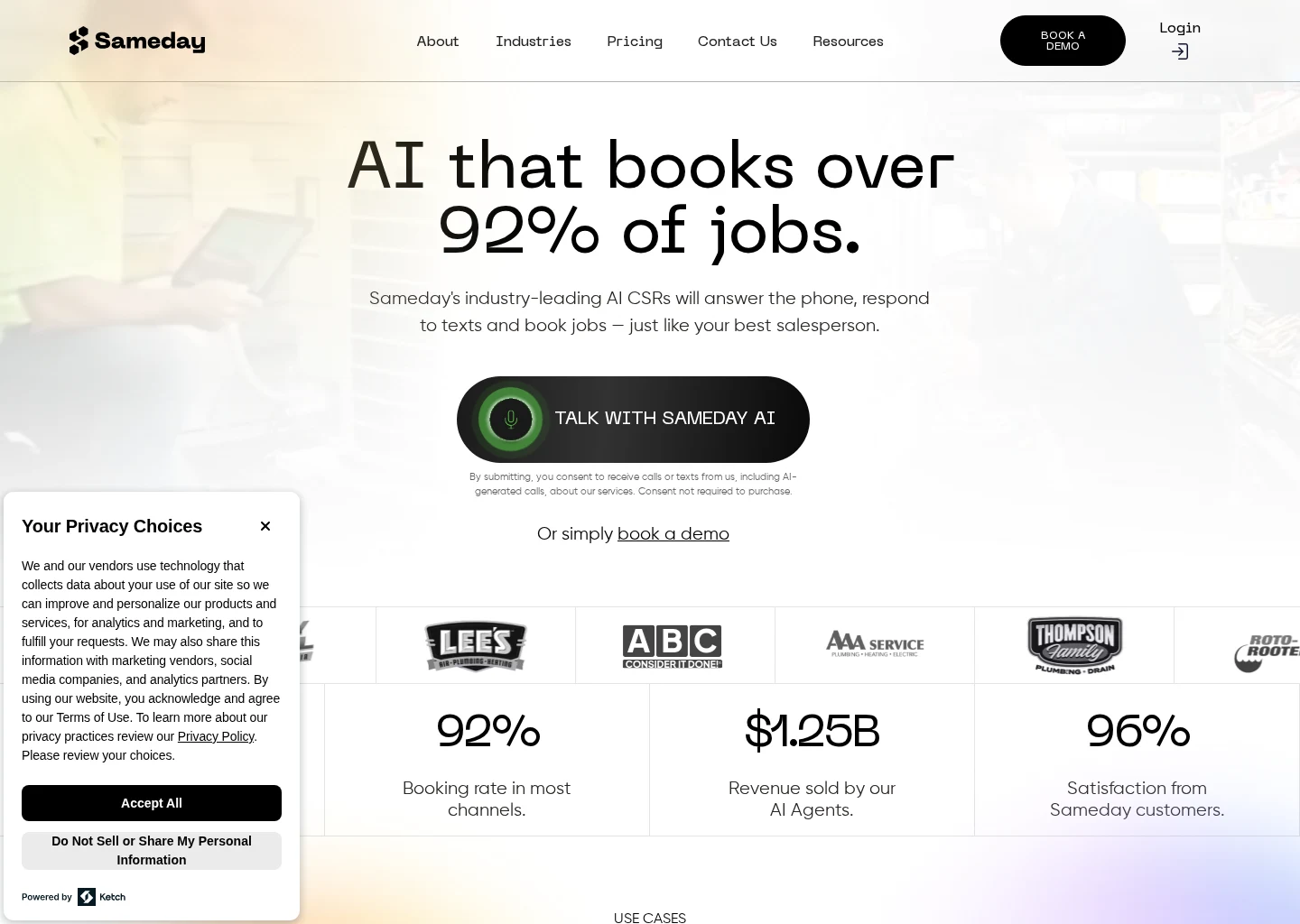
Sameday describes itself as an AI receptionist and scheduling product for home service businesses. In the current source set, that makes it one of the more directly aligned examples for landscaping buyers who want more than generic call handling.
What stands out from the reviewed material:
- home-service-specific positioning
- scheduling emphasis
- stated integrations with ServiceTitan and Housecall Pro
Why that matters for landscaping:
- home-service language often maps better to field scheduling than general business phone AI
- scheduling orientation is closer to booked-job outcomes
- integration direction suggests an effort to fit into existing service workflows
What to verify before choosing it:
- landscaping-specific intake flows
- how deep the booking workflow goes
- SMS continuation and follow-up logic
- pricing and onboarding scope
- whether review-request workflow is included
Smith.ai: hybrid AI receptionist example
Smith.ai describes itself as an AI and virtual receptionist provider with human-backed answering options. That makes it a useful example for landscaping companies that want automation plus human coverage.
Where it may fit well:
- call overflow coverage
- after-hours handling
- businesses with more edge-case conversations
- teams that want help before committing to full automation
What to verify:
- whether it truly supports booking depth or mainly handles intake
- how well it maps to landscaping-specific qualification
- how downstream SMS and review workflows are handled
- pricing structure at your expected call volume
If your main problem is missed calls rather than full workflow consolidation, Smith.ai may be a reasonable category to evaluate.
Goodcall: configurable AI phone platform example
Goodcall describes itself as a configurable AI phone platform for call handling and follow-up workflows. That is a different proposition from a home-service-specific AI receptionist.
Where it may fit:
- teams with custom routing needs
- operators with an existing workflow stack
- businesses that want configurable call and text handling layered into other systems
What landscaping buyers should press on in a demo:
- whether intake is trade-specific or mostly generic
- how much native booking support exists
- how easy owner control is without technical overhead
- what setup actually requires
Goodcall may be attractive when configurability matters most, but buyers should verify how much landscaping workflow comes ready versus how much must be built.
Avoca: contact-center oriented example
Avoca describes itself as an AI contact center platform focused on higher-volume service operations with CRM integrations. That positions it differently from a lightweight AI front desk for an owner-led landscaping company.
Where it may fit:
- larger service organizations
- higher call volume
- more formal queueing or support operations
Where buyers should be careful:
- implementation complexity may exceed what a local landscaping business needs
- the real workflow may be simple booking and follow-up, not a full contact-center layer
- operational overhead should be weighed against the value of additional routing depth
Fair comparison points for AgentZap, Jobber, Housecall Pro, and ServiceTitan
AgentZap: ask for proof in real landscaping scenarios
AgentZap is a name some buyers will encounter, but the reviewed evidence here is too thin to support a confident feature-by-feature ranking. The fair way to compare AgentZap is to inspect the real workflow, not the category label.
Ask to see these use cases live:
- a new landscaping estimate request
- an after-hours irrigation problem
- a current customer rescheduling service
- a missed call that turns into SMS follow-up
- a completed job that should trigger a review request
Verify:
- trade-specific intake quality
- urgency routing
- direct booking versus message capture
- owner approvals
- review and follow-up workflow
- actual integrations you need
Jobber: strongest question is workflow depth inside the stack
Jobber has AI receptionist positioning that makes it relevant for current users. For landscaping buyers, the key issue is not whether Jobber has AI branding. It is how much of the front-desk workflow can stay inside the operating system you already use.
Verify:
- whether the AI receptionist books jobs, qualifies leads, or mainly answers and routes
- how well it handles landscaping service categories
- whether SMS follow-up is part of the same motion
- what owner controls exist
- how review requests connect to completed work
If you already run scheduling and customer records in Jobber, compare the cost and friction of staying in-stack versus adding a separate front-desk layer. That same logic applies across the broader AI answering workflow comparison.
Housecall Pro: compare native workflow versus added answering layer
Housecall Pro matters in this comparison because many home service teams already operate from it, and some AI front desk vendors explicitly connect to it.
For Housecall Pro users, verify:
- whether inbound calls can become dispatch-ready records without manual cleanup
- whether after-hours and missed-call text-back are handled cleanly
- how landscaping intake categories are configured
- whether owner approval logic exists before booking
- whether follow-up and reviews stay connected to the same customer workflow
If the answer is mostly routing rather than true front-desk workflow, a separate AI front desk may still be worth evaluating.
ServiceTitan: strongest fit questions are scale, control, and workflow handoff
ServiceTitan users often need more control over workflow depth, data handoff, and scheduling logic. That can make ServiceTitan a strong reference point, but buyers should still test the front-desk motion directly.
Verify:
- whether the AI receptionist captures the intake data your CSR or dispatcher actually needs
- how calls move into estimates, jobs, or follow-up
- whether after-hours coverage creates clean next-day workflow
- what owner or manager approval controls are available
- whether review requests and customer communication stay connected after the job
If your landscaping business is growing into a more structured office operation, ServiceTitan-related workflows may deserve more attention than a lightweight standalone phone bot.
Demo scenarios every landscaping buyer should test
Scenario 1: new recurring maintenance lead
Ask the AI front desk to handle a new customer asking for ongoing mowing or maintenance. It should collect service address, property type, timing, and next-step preference without creating cleanup for the office.
Scenario 2: after-hours irrigation issue
This is the fastest way to test urgency handling. You want to see whether the system can distinguish a true urgent issue from a non-urgent request and route it correctly.
Scenario 3: current customer reschedule
A good AI receptionist should not treat existing customers like brand-new leads. It should recognize the workflow difference and move the request into the right follow-up path.
Scenario 4: missed call that turns into SMS
If your main revenue leak is missed calls during field hours, ask to see the exact missed-call-to-text workflow. That is often where AI front desk ROI is won or lost.
Scenario 5: completed job that triggers a review request
If reviews matter to your growth, test whether the workflow continues beyond intake and scheduling. For many owner-led teams, that connected workflow matters as much as the initial call answer. That broader service-business context is covered on Landscaping.
Final recommendation
For most owner-led landscaping companies, the best AI front desk is a workflow-first system that connects call answering, SMS, booking or scheduling handoff, follow-up, owner controls, and reviews.
That does not mean the same vendor is best for every company:
- MyBusinessFlow is a sensible option to evaluate if you want one workflow across calls, texts, booking, follow-up, owner visibility, and reviews.
- Sameday is a relevant example if you want home-service-specific AI receptionist positioning.
- Smith.ai is a relevant example if you want hybrid AI plus human answering coverage.
- Goodcall is worth a look if configurability matters most.
- Avoca is more likely to fit larger-volume routing environments than typical owner-led landscaping operations.
- AgentZap, Jobber, Housecall Pro, and ServiceTitan should be judged on real workflow proof, not broad messaging.
The right choice is the one that reliably turns landscaping inquiries into qualified, routed, and booked work with less owner interruption.
Sources