Why this matters
Build authority around missed calls, after-hours coverage, call overflow, and AI front desk workflows that turn calls into booked jobs.
Short Answer
For AI call answering for landscaping companies, the first workflow to prioritize is after-hours quote request intake that qualifies the lead and creates a booked follow-up or clean next-day handoff.
That is usually the most commercially sensible choice because landscaping teams do not lose after-hours calls just because no one spoke to the caller. They lose them when the call breaks the chain between initial inquiry and scheduled next action. If the system only takes a message, the office still starts cold the next morning. If it captures the right details and turns them into a scheduled estimate, callback task, or CRM/FSM record, you preserve lead-to-booking continuity without adding more front-desk headcount during peak season.
The related query “AI call overflow for home service businesses” points to the same decision. Whether you need overflow during busy periods or full after-hours coverage, the real buying question is: Will this workflow protect quote demand and move it toward a booked job?
This guide prioritizes the workflows most tied to booked jobs and revenue: response speed, qualification quality, scheduling coverage, emergency routing, and CRM/FSM fit. The vendor examples below come from reviewed vendor materials rather than independent comparative testing, and pricing, setup scope, and integration depth are not consistently documented, so verify those points in demos and pilots.
If you want broader category context, you can review the AI call answering hub.
Why After-Hours Answering Matters in Landscaping
Missed calls break quote momentum
Landscaping is especially exposed to missed-call leakage because much of inbound demand is quote-driven. People call when they need mowing, cleanup, irrigation work, hardscaping, or recurring maintenance. Many of those calls happen outside normal office coverage, especially in the evening and on weekends.
When no one answers, three things happen quickly:
- The prospect moves on to another company
- Job details never get captured cleanly
- Your office starts the next day with a callback list instead of scheduled opportunities
That is why after-hours coverage is not just a convenience layer. It is a revenue-protection workflow.
Seasonal staffing makes the gap more expensive
This becomes more urgent during busy months. Call volume rises at the same time field schedules tighten, office staff get stretched, and temporary admin hiring gets harder to justify. In that environment, automation is attractive because it can extend coverage without increasing payroll in direct proportion to seasonal demand.
If you are comparing trade-specific needs against a broader service workflow, it helps to look at both your landscaping operating context and the underlying after-hours answering workflow.
What Buyers Are Actually Purchasing
This is a workflow decision, not just a phone decision
Most buyers start by asking about AI answering. The actual purchase is broader: a system that can
- Respond immediately
- Collect enough structured information to move the opportunity forward
- Trigger the right next step without manual cleanup
That is different from basic message taking.
For landscaping, a weak system says, “Someone will call you back.” A stronger system says, “I can help with that. What service do you need, what is the property address, and what is the best time for follow-up?” Then it records that information where the team can act on it.
Success means booked follow-up, not answered audio
After-hours success is not measured by whether the phone was technically answered. It is measured by whether the call becomes a booked estimate, qualified lead, or correctly routed opportunity.
That is the lens to use when you compare tools in the AI call answering category.
The Workflow to Prioritize First
The first workflow to implement should be:
After-hours quote request intake → qualification → booked follow-up or scheduled callback
That should come before more ambitious projects like broad call deflection, advanced upsell paths, or highly customized conversation trees.
Step 1: Identify the call type quickly
The system should quickly determine whether the caller is:
- Requesting a new quote
- Calling about an existing job
- Asking about recurring service
- Reporting something urgent that needs escalation
- Calling for something outside your service area or scope
This matters because a new quote request needs a different path than billing, support, or existing-customer questions.
Step 2: Capture the minimum data that makes the lead usable
For a landscaping estimate, the goal is not a perfect discovery call after hours. The goal is to preserve momentum with usable information, including:
- Name
- Phone number
- Property address
- Service type
- Timing preference
- Basic property or project notes
Step 3: Create the next action automatically
The most valuable output is not a transcript. It is a next action inside your workflow, such as:
- A booked estimate slot
- A scheduled callback window
- A CRM lead record
- An FSM job request
- A routed follow-up task for the right person
If your after-hours setup cannot reliably create one of those outcomes, it is probably not solving the core problem. You can compare that requirement against a dedicated after-hours answering workflow when evaluating demos.
What Quote Request Intake Should Capture
The right intake fields depend on whether you sell recurring maintenance, one-time services, or larger projects. Still, most landscaping teams should structure after-hours quote intake around a few common categories.
Property and service details
The first job is to understand what kind of work the caller wants.
Useful fields often include:
- Mowing or maintenance
- Cleanup
- Mulching
- Shrub or tree trimming
- Irrigation-related request
- Hardscaping or design-build interest
- Residential or commercial property type
- Property address
If the system cannot separate these request types, the office may still waste time requalifying leads the next day.
Timing and urgency signals
Landscaping is not always emergency-driven, but some calls do need faster routing. Storm cleanup, drainage issues, irrigation problems, or event-related property prep can require different handling than routine quote requests.
Useful prompts include:
- Preferred service date or window
- Whether the work is urgent
- Whether the caller wants recurring service or a one-time job
- Best callback time
Contact and follow-up preference
A strong workflow should also preserve how the caller wants to continue the conversation.
Useful fields include:
- Primary contact number
- Email, if your office uses it for estimates
- Text-friendly or call-only preference
- Best contact for site access or approval
Lead-to-Booking Continuity Is the Deciding Factor
Why continuity matters more than voice polish
If there is one buying criterion to keep front and center, it is lead-to-booking continuity.
That means the caller’s intent survives the full path from first ring to team follow-up. No dropped notes. No vague inbox messages. No next-morning detective work to reconstruct what the customer wanted.
For landscaping companies, that continuity matters because quote demand moves quickly. A homeowner looking for weekly service or a cleanup quote may contact several providers in the same evening. The company that answers clearly and follows through cleanly has an operational advantage.
Where continuity usually breaks
Continuity usually depends on four things working together:
- The call is answered
- The request is categorized correctly
- The intake record lands in the right system
- The next action is assigned or booked
When you evaluate tools, those four points matter more than how polished the demo voice sounds.
Seasonal Staffing Constraints Change the ROI
The business case is coverage without matching headcount growth
Seasonal labor pressure is one of the strongest reasons landscaping buyers look at AI front desk coverage now.
During peak months, office teams are usually handling schedule changes, crew communication, weather disruption, customer updates, and new quote requests at the same time. Adding another full front-desk role may not make sense if demand is seasonal rather than stable year-round.
An AI answering layer can be financially compelling when it helps you:
- Extend phone coverage beyond office hours
- Absorb call spikes without pushing prospects to voicemail
- Keep admin staff focused on higher-value follow-up
- Protect inbound quote opportunities without immediate headcount growth
The goal is not to replace judgment-heavy office work. The goal is to reduce the repeated failure mode of missed first contact. Teams comparing that tradeoff can also use the landscaping overview to pressure-test fit against real operating conditions.
What Strong Solutions Need to Do
A strong solution for landscaping after-hours answering should be judged by workflow fit, not by broad AI language.
Response speed
The system should answer quickly enough that callers do not abandon and try another provider. Speed matters most on quote-driven calls, where the first interaction often shapes who gets the estimate.
Qualification quality
The system should collect information that is actually usable for office follow-up. Good qualification is not the same as a long conversation. It means the intake is structured enough that your team can act without starting over.
Scheduling coverage
The system should support one of these outcomes clearly:
- Direct estimate scheduling
- Scheduled callback windows
- Task creation for office follow-up
If it only captures a message, verify whether that is enough for your office process.
Emergency routing and exceptions
Landscaping teams still need clear rules. For example:
- New quote requests go to one path
- Existing customers go to another
- Urgent property issues escalate differently
- Out-of-area leads get filtered early
If routing logic is unclear, ask the vendor to show a live example.
CRM or FSM fit
This is one of the most important technical checks.
In the reviewed vendor materials:
- Sameday lists integrations with ServiceTitan and Housecall Pro
- Avoca references CRM integration
- Goodcall references API and CRM integrations
What is not clearly documented matters too: pricing, implementation scope, landscaping-specific templates, integration depth, and how much setup your team must own. Those details often determine whether the workflow holds up after launch. If you are mapping this to a broader deployment, the after-hours answering page provides the workflow frame to use in demos.
Reviewability and quality control
You should be able to inspect what happened on calls. In practice, that usually means reviewing:
- Captured lead fields
- Call summaries or transcripts
- Routing outcomes
- Booked follow-up accuracy
Without reviewability, it is difficult to improve performance over time.
How the Reviewed Vendor Positioning Maps to Landscaping Needs
The vendors below are best used as examples from the current evidence set, not as a full market ranking.
Sameday
Sameday describes itself as an AI receptionist and scheduling product for home service businesses. Its site also lists integrations with ServiceTitan and Housecall Pro.
That makes it a reasonable option to check if you want a workflow centered on reception and scheduling and your stack already includes one of those platforms.
Verify:
- Whether landscaping quote workflows are prebuilt or need customization
- How after-hours intake becomes an estimate, job, or callback
- How recurring service requests are handled
- What happens when a request needs office review rather than immediate booking
- Pricing and implementation scope
Avoca
Avoca describes itself as an AI contact center platform for high-volume service businesses and says it integrates with CRMs.
That may be more relevant for landscaping companies with heavier call volume, centralized phone operations, or a broader service queue than a smaller owner-led office.
Verify:
- Whether the platform supports landscaping-specific quote intake depth
- How CRM integration works in practice
- Whether scheduling is native, assisted, or dependent on downstream tools
- What “high-volume” means for your team size and call mix
- Pricing and onboarding effort
Goodcall
Goodcall describes itself as an AI phone platform for configurable call handling and follow-up workflows and references API and CRM integrations.
That may fit buyers who want more configurable call logic or need the phone workflow to connect to a broader internal system.
Verify:
- How much configuration is required to reach a landscaping-ready workflow
- Whether quote intake fields can be structured the way your office needs
- Whether booking is native or dependent on external setup
- Whether your team has the operational capacity to manage a more configurable system
- Pricing, support, and setup burden
AI Call Overflow for Home Service Businesses Maps to the Same Buying Decision
For landscaping companies, “AI call answering” and “AI call overflow” are usually not separate software questions. They are the same workflow decision with different trigger points.
After-hours and overflow are two versions of the same problem
- After-hours answering covers calls when your office is closed
- Overflow answering catches calls when staff are busy, queues spike, or seasonal demand surges
The evaluation criteria stay mostly the same:
- Can it identify quote requests quickly?
- Can it capture usable intake details?
- Can it route or book the next action?
- Can it fit your CRM or FSM process?
- Can your team review outcomes and correct mistakes?
For landscaping teams, the practical answer is usually the same: buy for the workflow, not the label. The broader AI call answering hub covers the category, but the buying test remains lead-to-booking continuity.
Questions to Verify Before You Buy
Good demos and good implementations are not always the same. Ask direct operational questions before signing.
Intake and qualification
- What exact fields can the system capture for a landscaping quote request?
- Can it distinguish between maintenance, cleanup, irrigation, and larger project inquiries?
- Can it recognize recurring service requests versus one-time jobs?
Booking and routing
- Can it book an estimate, or does it only log a message?
- What happens if the requested service is outside our service area or scope?
- How are urgent calls handled after hours?
Systems, setup, and pricing
- Which CRM or FSM integrations are live today, and what is the depth of sync?
- How much setup do we own versus the vendor?
- How do we review calls, corrections, and missed intents?
- What does onboarding actually involve for our office team?
- What pricing model applies, and what usage limits or add-ons matter?
If you want to compare those checks against your trade workflow, you can also review the landscaping page.
Common Buying Mistakes
Buying for novelty instead of workflow fit
A natural-sounding voice is not the same as a reliable intake process. If the system sounds good but does not create usable next actions, it will not protect revenue.
Treating after-hours coverage as message taking
If the only improvement over voicemail is a cleaner message log, the office still carries the same follow-up burden.
Ignoring integration reality
A claimed CRM or API connection is not the same as a proven workflow inside your stack. Ask what actually syncs, what fails gracefully, and what your team still has to do manually.
Overcomplicating the first deployment
Start with the highest-value path: quote request intake and booked follow-up. Expand after that works.
Final Recommendation
For AI call answering for landscaping companies, prioritize an after-hours quote intake workflow that preserves lead-to-booking continuity. That is the most defensible direction for quote-heavy inbound demand, especially when seasonal staffing constraints make extra front-desk coverage difficult to add.
In practical terms, buy only if the system can do most or all of the following:
- Answer the call immediately
- Recognize a new quote request
- Capture structured service and property details
- Determine urgency or routing needs
- Create a booked follow-up, callback task, or system record your team can act on
Based on the reviewed vendor materials, the named vendors are best treated as examples of different approaches, not a fully proven shortlist:
- Sameday may fit teams that want home-service-oriented receptionist and scheduling positioning, especially if ServiceTitan or Housecall Pro already matter in the stack
- Avoca may fit teams evaluating higher-volume, contact-center-style operations with CRM connectivity
- Goodcall may fit teams that need configurable phone workflows tied to API or CRM-based follow-up
If your evaluation still has thin comparative evidence, do not force a stronger vendor conclusion than the facts support. Verify booking depth, routing quality, integration reality, pricing, and setup burden. For landscaping companies, those checks determine whether after-hours calls become booked work or simply turn into another morning callback pile.
If you want to see how an AI front desk workflow is set up in practice, you can review Get Started.
FAQ
Can AI answer quote requests for landscaping companies after hours?
Yes. A common use case is answering after-hours quote calls, collecting structured details, and creating a usable next step. The key distinction is whether the system only takes a message or actually supports follow-up continuity.
What matters more: AI call answering or AI call overflow?
For most landscaping companies, they are variations of the same buying decision. The real question is whether the system maintains continuity from inbound call to booked follow-up.
Do landscaping companies need full booking or just callback capture?
That depends on your office process, but in quote-heavy environments, a system that supports booking or at least structured callback scheduling is usually more useful than simple message capture.
Which integrations matter most?
The integrations tied to your real workflow. In the reviewed vendor materials, named examples include ServiceTitan, Housecall Pro, CRM, and API connections. Buyers should verify exactly what syncs, how reliably it syncs, and what the office team still needs to do manually.
Where should a landscaping company start?
Start with the highest-value workflow: after-hours quote request intake tied to a booked follow-up or scheduled callback. If you need broader category context before shortlisting vendors, the AI call answering hub and after-hours answering overview provide the surrounding framework.
Supporting visuals
Visual proof and context
Screenshots and images that support this article, with sources noted.
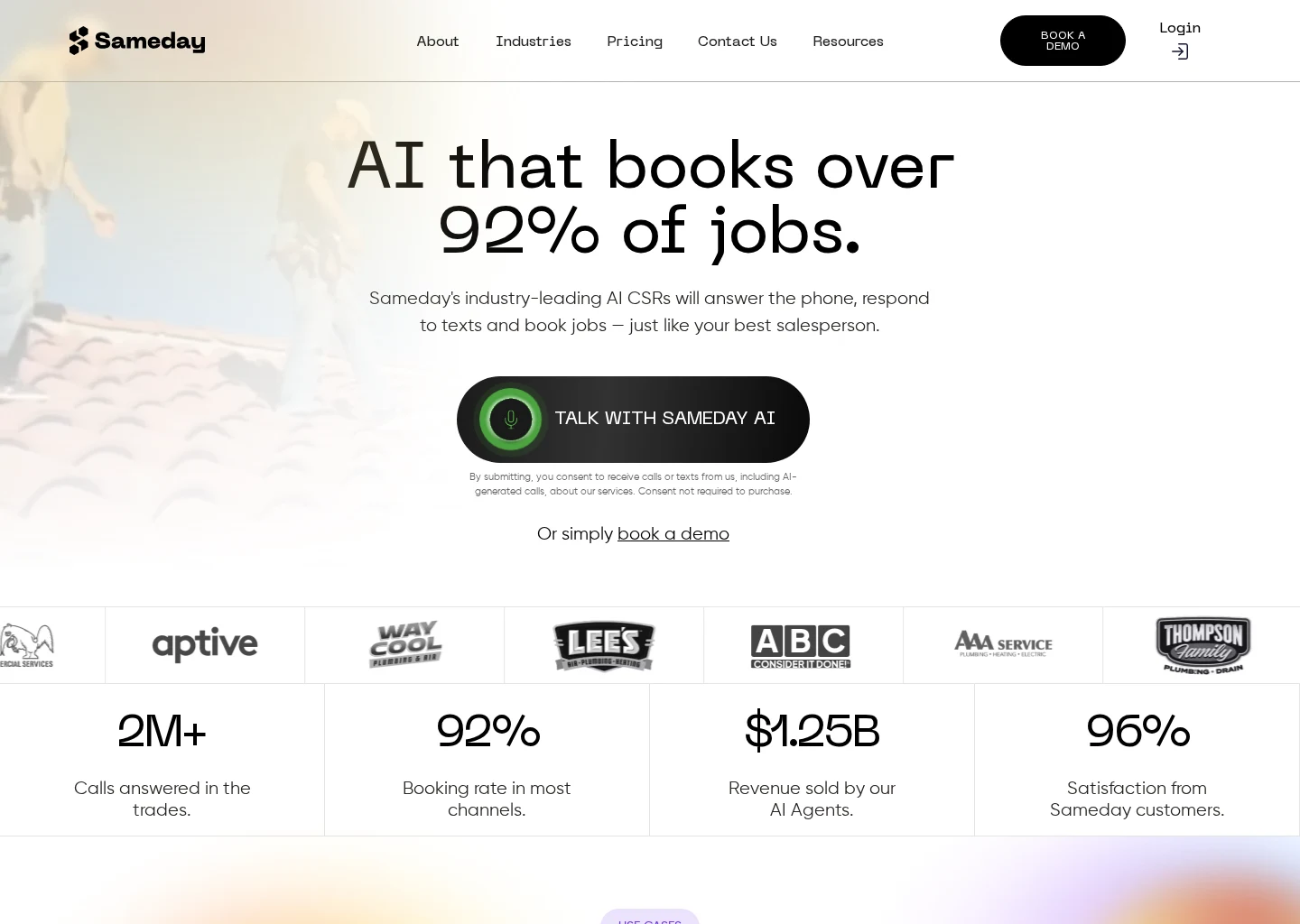
Source-backed evidence from www.sameday.ai
Captured evidence
SourceFrequently Asked Questions
Sources