Why this matters
Build authority around missed calls, after-hours coverage, call overflow, and AI front desk workflows that turn calls into booked jobs.
Short Answer
For most landscaping companies, the highest-value use of AI call overflow is not a generic answering layer and not a pseudo-emergency dispatch workflow. It is a lead-capture and consultation-qualification workflow built for seasonal quote spikes, after-hours calls, and front-office overload.
In practice, that means your overflow system should do four things well:
- Answer missed or overflow calls immediately
- Qualify the inquiry before booking a consultation
- Separate urgent property issues from routine inquiries
- Send SMS follow-up to homeowners who are still comparing providers
That workflow is commercially sensible because landscaping demand is uneven. Spring, early summer, and post-storm surges create periods where callback delays turn directly into lost estimate opportunities. Many homeowners call several providers in the same window. If your office cannot respond quickly, confirm service fit, and move qualified leads forward, the revenue leak is immediate.
This article uses a narrow evidence set: four vendor-owned sources and no independent pricing or performance benchmarks. That is enough to compare workflow direction, but not enough to name a universal winner. For broader category context, see the AI Call Answering Hub and After-Hours Answering.
Why This Matters for Landscaping Companies
Landscaping companies usually do not lose business because the phone never rings. They lose business because the phone rings too much at the wrong times.
Seasonal quote spikes create exactly that problem. A warm-weather rush, a storm-related burst of inbound interest, a push on weekly maintenance, or a sudden wave of design-build inquiries can overwhelm a small office team quickly. While crews are in the field and staff are already serving current customers, new estimate requests pile up.
The three revenue problems caused by overflow
When that happens, three expensive issues tend to show up at once:
- Missed first-contact opportunities
- Slow callbacks on high-intent quote requests
- Low-quality bookings that waste estimator time
The first is obvious: if no one answers, some callers move on.
The second is often more costly. Landscaping buyers frequently contact multiple companies in a short window. By the time your team calls back, the homeowner may already have two consultations scheduled elsewhere.
The third problem is quieter but still expensive. If overflow handling simply books everyone, your estimators end up visiting properties that are outside your service area, outside your scope, not ready to buy, or asking for work your company does not prioritize.
That is why AI call overflow for landscaping should be judged on response speed plus qualification quality, not on pickup rate alone.
Evidence Snapshot
The current evidence base here comes from four vendor sources:
- Sameday
- Avoca
- Goodcall
- Smith.ai
There are no independent editorial reviews in the source set, no verified public pricing comparison, and no neutral landscaping-specific performance tests. Use the available evidence to assess workflow fit, then verify setup, integration depth, and booking logic in demos.
What Strong Landscaping Overflow Workflows Need to Do
A landscaping call overflow setup should support the full front-desk workflow, not just answer a ringing line.
Capture every overflow call without adding friction
The system should answer quickly when:
- your receptionist is busy
- the office is closed
- call volume spikes beyond staff capacity
- a missed call would otherwise go to voicemail
For landscaping, fast response matters most during quote surges and maintenance season. A caller asking about lawn care, cleanup, irrigation, or a landscape redesign consultation is often ready to talk now, not tomorrow. This is one reason many teams evaluate overflow alongside after-hours answering, not as a separate problem.
Qualify before booking consultations
This is the workflow priority that matters most.
A strong AI overflow setup should collect the minimum information needed to decide whether a consultation belongs on the calendar. That often includes:
- property address or ZIP code
- requested service type
- timeline
- residential or commercial status
- project size or general scope
- whether the caller is a new or existing customer
Without this step, automation can fill the calendar while weakening the pipeline.
Separate urgent property issues from routine inquiries
Landscaping is not the same as 24/7 emergency dispatch. Most calls are routine: estimates, schedule questions, maintenance changes, billing, and service requests.
Still, some inbound calls deserve faster escalation. Examples include time-sensitive property damage concerns, active site issues, or customer situations that should not wait for the next callback window. Your overflow workflow should recognize those cases and route them differently without turning the whole phone tree into an emergency operation.
Trigger follow-up automatically
A missed chance to book is not always a lost lead if the follow-up is immediate and useful.
For landscaping buyers, SMS follow-up is especially valuable because many homeowners are comparison shopping. If they call after hours or during a surge and do not commit right away, a fast text can preserve the opportunity by confirming receipt, setting expectations, and making it easy to continue the conversation.
The Workflow to Prioritize
If you are buying specifically for call overflow, prioritize this sequence:
- Answer overflow instantly
- Identify whether the caller is an existing customer or a new lead
- Capture location and service type
- Check fit before offering a consultation
- Book qualified consultations into approved slots
- Route urgent property issues for faster review
- Send SMS confirmation and follow-up
Why this sequence works for landscaping
This sequence is stronger than a basic “answer everything and take a message” model because it protects both revenue and schedule quality.
For landscaping companies, consultation slots are limited and estimator time is expensive. Sending crews or estimators to poor-fit appointments can be nearly as damaging as missing calls. The goal is not maximum automation for its own sake. The goal is using overflow coverage to convert more good opportunities into booked, qualified consultations.
This is also how the broader query “AI call overflow for home service businesses” maps back to landscaping. Landscaping buyers should interpret that category through a narrower lens:
- not every inquiry should be booked
- service area matters
- seasonality matters
- project fit matters
- comparison-shopping behavior matters
For a broader overview of category options, the AI Call Answering Hub covers common answering and front-desk patterns across service businesses.
Qualification Before Booking Consultations
Qualification is where overflow systems either create leverage or create noise.
Questions your AI workflow should capture
Before a consultation is booked, the system should usually clarify:
- What service is the caller asking for?
- Is the property inside your service area?
- Is this ongoing maintenance, a one-time service, or a larger project?
- How soon does the customer want service?
- Is this a homeowner, property manager, or commercial account?
- Is there anything time-sensitive about the property issue?
Those questions help your team avoid putting the wrong jobs into the wrong calendar lanes.
Useful questions that may require verification
Some buyers will also want AI to ask about budget range, lot size, gate access, irrigation context, or photo collection by text. Those can be useful, but the supplied sources do not consistently document that level of landscaping-specific workflow depth. If those details matter to your operation, ask the vendor to demonstrate the exact scenario live.
The booking rule that matters most
Do not book every caller who sounds interested.
Instead, define clear rules for when a consultation should go directly onto the calendar versus when the lead should be held for review. For example:
- book only if inside the service area
- book only for approved service categories
- hold large or unusual projects for staff review
- route commercial requests to a different path
- send non-fit inquiries to a polite follow-up instead of a calendar slot
That is how overflow coverage improves booking quality rather than just creating activity.
Why SMS Follow-Up Matters for Landscaping Buyers
SMS follow-up is not a side feature in this use case. It is part of conversion.
Homeowners comparing landscaping providers often do not decide on the first call. They want to know who serves their area, who can come out soon, and who seems easiest to work with. A timely text helps your company stay in that decision set.
What good SMS follow-up can do
Useful SMS follow-up can help with:
- confirming that the inquiry was received
- restating the requested service
- sharing the next step for booking
- prompting photo submission if your process supports it
- reducing no-response drift after an after-hours call
A simple, well-timed message can outperform a voicemail callback because it meets the customer in a lower-friction format. This is especially important during seasonal quote spikes, when your office may not be able to return every inquiry immediately but still needs to hold attention long enough to convert the right opportunities.
Related workflow considerations also show up in after-hours answering, where speed and follow-up discipline often matter more than long feature lists.
Route Urgent Property Issues Without Treating Landscaping Like Emergency Dispatch
One of the most common mistakes in this category is overcorrecting toward urgency.
Most landscaping overflow does not need the logic of emergency trades. A landscaping company usually needs calm triage, not a 24/7 incident command center. If you build the workflow like every call is urgent, you create unnecessary interruptions and poor escalation habits.
Use a two-lane triage model
A better model is simple:
- Routine lane: estimates, scheduling, maintenance changes, billing, general questions
- Urgent property issue lane: time-sensitive concerns that may require faster human review
That distinction lets you respond intelligently without turning your business into an always-on dispatch operation.
What may justify faster handling
Examples of issues that may need quicker review include:
- an active property issue causing visible damage concerns
- a situation that could worsen significantly before the next office window
- a current customer with a time-sensitive site problem
What counts as “urgent” will vary by company, and the source set does not define landscaping-specific escalation standards for any vendor. Buyers should script this carefully and test real call flows before launch.
How the “Home Service Businesses” Query Maps Back to Landscaping
The broader search term “AI call overflow for home service businesses” points to a larger software category, but the buying decision for landscaping is narrower.
The landscaping-specific buying questions
A landscaping owner should translate that category language into practical questions:
- Can it handle quote-request surges without losing callers?
- Can it qualify leads before booking consultations?
- Can it send SMS follow-up for comparison shoppers?
- Can it route urgent property issues differently from routine calls?
- Can it fit the systems and scheduling process we already use?
That is why generic call-answering language is not enough. A home-service platform may sound relevant, but unless it supports your actual front-desk workflow, it may answer more calls without improving booked revenue.
Examples From the Current Evidence Set
The vendors below are examples from the available evidence, not a complete market map.
Sameday
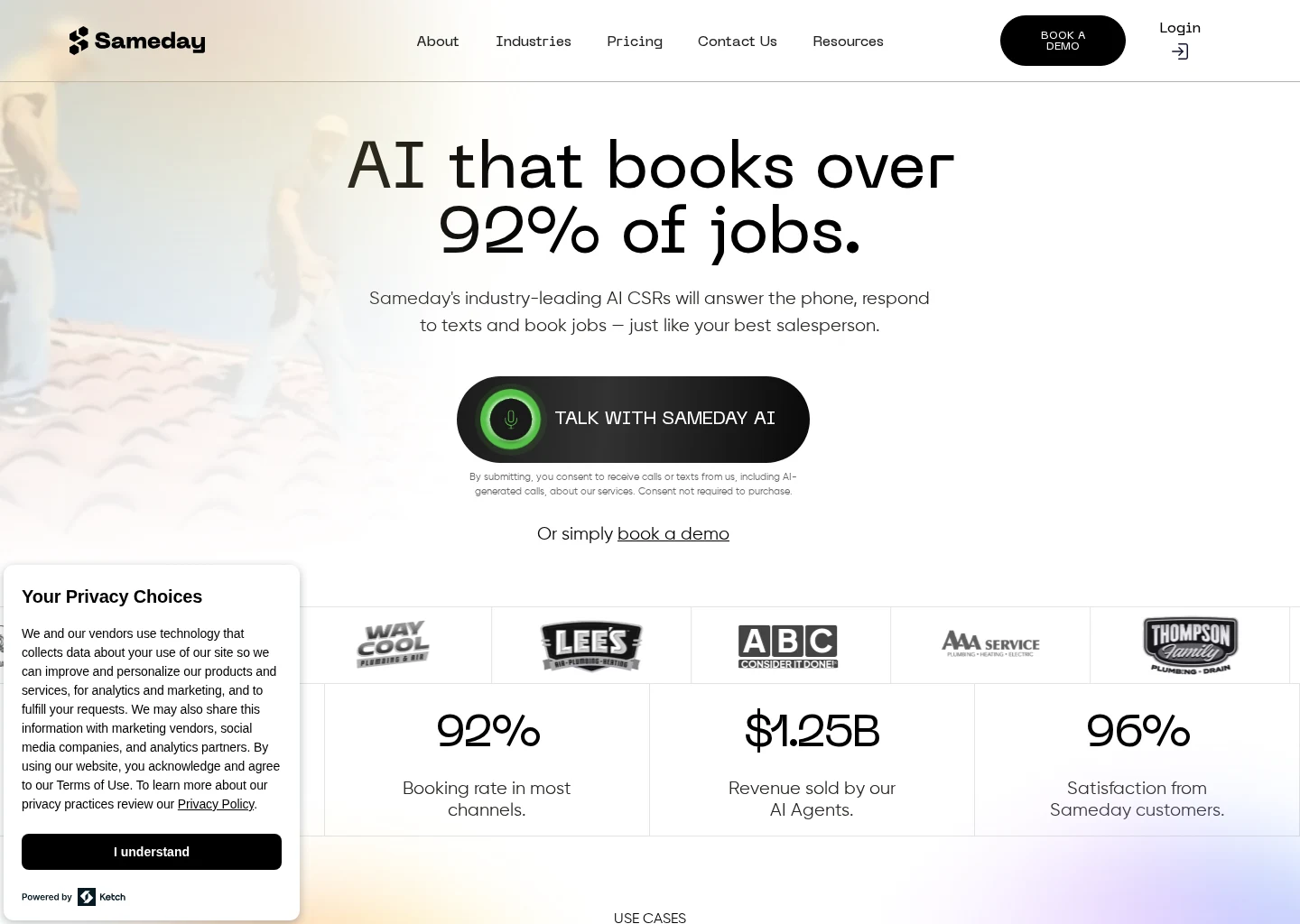
Sameday describes itself as an AI receptionist and scheduling product for home service businesses. That home-service orientation is relevant for landscaping buyers because the core use case overlaps with overflow answering, appointment handling, and scheduling. The source pack also notes integrations with ServiceTitan and Housecall Pro.
What is less clear from the supplied evidence is how deeply Sameday supports landscaping-specific qualification logic, what pricing looks like, and how much setup is required to tune booking rules for consultation-heavy workflows.
Avoca
Avoca describes itself as an AI contact center platform focused on high-volume service businesses. That makes it relevant for teams dealing with heavy inbound volume during seasonal surges. The evidence set notes CRM integration.
The open question for a landscaping buyer is whether that contact-center orientation is the right fit for a smaller field-service office versus a more operationally complex service business. Buyers should verify the level of customization for qualification, routing, and scheduling handoff.
Goodcall
Goodcall describes itself as a general AI phone platform for configurable call handling and follow-up workflows. The main appeal here is flexibility. The evidence set notes API and CRM integrations, which may matter if your process depends on custom routing or follow-up automation.
Because Goodcall is positioned horizontally rather than specifically around landscaping or home services, buyers should verify how much configuration work is required to make it behave like a landscaping front desk instead of a general AI phone tool.
Smith.ai
Smith.ai describes itself as an AI and virtual receptionist provider with human-backed call answering options. The evidence set notes CRM, calendar, and Zapier integrations. That hybrid angle may matter to landscaping companies that want overflow automation but also want some calls handled with human support.
The available sources do not establish how Smith.ai compares on landscaping-specific qualification depth, and they do not clarify the practical cost tradeoff of AI-only versus human-backed workflows for this use case.
Questions to Verify Before You Buy
Because the source material does not answer every implementation question, buyers should verify the following in demos and trial calls.
Can it qualify before it books?
Ask the vendor to show:
- service-area screening
- new lead versus existing customer logic
- consultation-only booking rules
- non-fit inquiry handling
- manual review paths for large or unusual projects
If the workflow jumps to “let’s get you scheduled” too early, it may create more bad appointments than good ones.
Can it support SMS follow-up for undecided homeowners?
Ask what happens when a caller:
- reaches overflow after hours
- does not finish booking
- wants a callback
- is comparing providers and not ready to commit
The ability to trigger useful SMS follow-up matters in landscaping because quote shoppers often continue the conversation by text.
How does it handle urgent property issues?
You do not need a full emergency-dispatch product. You do need clear escalation rules.
Ask whether the workflow can:
- flag urgent calls
- route them to a manager or on-call contact
- distinguish urgency without over-escalating routine inquiries
What systems does it connect to?
From the supplied evidence:
- Sameday: ServiceTitan, Housecall Pro
- Avoca: CRM
- Goodcall: API, CRM
- Smith.ai: CRM, calendar, Zapier
That is useful directional information, but not enough to assume your exact stack will work the way you need. Verify:
- your CRM or FSM
- your calendar rules
- contact creation logic
- duplicate handling
- note sync
- SMS logging
If you want to compare these requirements against a landscaping-specific workflow, the Landscaping page shows how front-desk needs often differ from generic service business setups.
Signs a Vendor Is a Fit for Landscaping Overflow
A strong fit usually looks like this:
- it answers overflow and after-hours calls quickly
- it can ask landscaping-relevant qualification questions
- it books only approved consultation types
- it supports SMS follow-up for homeowners who are still comparing providers
- it separates urgent property issues from routine inquiries
- it connects cleanly enough to your existing systems that staff will use it
A weak fit usually looks like this:
- it sounds impressive but only takes messages
- it books everything without screening
- it cannot control service-area logic
- it treats all urgency the same
- it requires too much manual cleanup after every call
If the demo sounds like a generic call-center script instead of your front office, that is a sign to keep testing.
Final Recommendation
If your office gets buried during seasonal quote and maintenance surges, buy AI call overflow for qualified consultation capture, not just for coverage.
What to prioritize
Focus on a workflow that:
- answers overflow immediately
- screens for service fit
- qualifies before booking consultations
- sends SMS follow-up to homeowners comparing providers
- escalates urgent property issues without turning landscaping into an emergency-dispatch model
How to choose between vendors
The current evidence does not justify naming a universal winner across all landscaping companies. It does support a clear buying direction: choose the system that protects booking quality under pressure.
Sameday, Avoca, Goodcall, and Smith.ai represent different workflow approaches in the current evidence set. The right choice depends less on brand positioning and more on whether the product can follow your service-area rules, qualification logic, scheduling process, and follow-up expectations.
If two vendors look similar, choose the one that can prove your exact overflow scenario in a live call flow:
- spring estimate spike
- after-hours homeowner inquiry
- comparison-shopping prospect
- urgent property issue requiring faster review
- qualified lead ready to book a consultation now
That is the practical test that matters. If you want to compare your process against a live AI front-desk model, Get Your Free AI Front Desk provides a product example you can evaluate alongside other options.
FAQ
What is AI call overflow for landscaping companies?
It is a workflow that answers calls your team cannot pick up live, especially during busy periods or after hours, then captures, qualifies, routes, and sometimes books those inquiries based on your business rules.
Should landscaping companies use AI to book estimates automatically?
Sometimes, but not blindly. The stronger approach is to qualify before booking consultations. If every caller goes straight onto the calendar, estimator time gets wasted on poor-fit opportunities.
Why is SMS follow-up important for landscaping overflow?
Because many homeowners are comparing providers. A fast SMS can confirm you received the inquiry, keep the lead warm, and reduce the drop-off that happens when callbacks are delayed.
Is this the same as AI call overflow for home service businesses?
It is the same category, but landscaping needs a narrower workflow. Service area, project type, seasonality, and consultation quality matter more than a generic “answer every call” promise.
Do I need emergency routing for landscaping calls?
Usually not in the way emergency trades do. You do need a way to separate urgent property issues from routine inquiries, but most landscaping overflow should be handled through structured triage rather than a full emergency-dispatch model.
Which vendors are relevant from the current evidence set?
The current source set includes Sameday, Avoca, Goodcall, and Smith.ai. They illustrate different approaches: home-service orientation, high-volume contact-center positioning, configurable phone workflows, and AI plus human-backed receptionist coverage. Buyers should verify real booking logic, integrations, and setup requirements before deciding.
Supporting visuals
Visual proof and context
Screenshots and images that support this article, with sources noted.
Source-backed evidence from www.gosameday.com
Captured evidence
SourceFrequently Asked Questions
Sources