Why this matters
Build authority around missed calls, after-hours coverage, call overflow, and AI front desk workflows that turn calls into booked jobs.
Short Answer
For roofing companies, the smartest way to buy AI call overflow is to prioritize a booking and qualification workflow, not a generic answering tool.
When storm-driven demand hits, the system should do three things reliably:
- capture every overflow call
- qualify whether the caller needs an estimate, an inspection, or urgent human review
- trigger follow-up immediately when the job cannot be booked on the first interaction
If a platform can answer calls but cannot move the lead into a confirmed next step, revenue still gets stranded in voicemail, callback lists, and incomplete notes.
That buying logic is commercially sensible because roofing overflow spikes fast and unevenly. Owners are not just dealing with more calls. They are dealing with more time-sensitive requests, more address-specific intake, and more pressure on office staff to schedule, route, and follow up without losing momentum. The winning workflow protects response speed without sacrificing lead quality.
In practice, most roofing buyers should look for AI overflow that can:
- answer missed, overflow, and after-hours calls
- collect contact details, property address, and basic roof issue context
- separate likely inspection requests from general estimate requests
- identify active leak or other urgent scenarios for escalation
- book inspections directly when scheduling rules allow
- send a follow-up text or handoff when photos or manual review are needed
- push outcomes into the CRM or field service system
That is also the core decision behind broader searches about AI call answering and AI call overflow for home service businesses. Roofing simply raises the stakes because missed calls can become missed jobs within hours.
The public evidence reviewed here is limited and primarily vendor-supplied, so the named products below are best treated as examples from the current evidence set. Buyers should verify pricing, setup, scheduling depth, integrations, escalation logic, and follow-up behavior in a live demo.
Why roofing call overflow gets expensive so quickly
Roofing overflow is not just an office inconvenience. It is a lead conversion problem, a scheduling problem, and a reputation problem at the same time.
When demand spikes after a storm or during a busy estimate week, three things usually happen:
- new callers hit voicemail or busy lines
- office staff start triaging without enough structure
- follow-up slows down after the first call
That combination gets expensive fast. A homeowner who cannot reach you today may call another contractor in minutes. Even when the job does not book immediately, the first company to capture the address, roof issue, and next step often gains the advantage. That is especially true for roofing businesses working through concentrated local demand.
Storm surges create a different call mix
A storm-driven spike usually includes several call types at once:
- active leak concerns
- visible storm damage reports
- inspection requests
- estimate requests from non-urgent callers
- status questions from existing customers
- general office questions that still consume staff time
A weak overflow setup treats all of those calls the same. A stronger one routes them into different outcomes.
Missed calls create downstream administrative waste
Even when a lead is still recoverable, a missed or poorly captured call creates extra work:
- manual callback lists
- incomplete notes
- duplicate entries
- unclear urgency
- scheduling backlogs
- weak handoff from office to field
That is why workflow fit matters more than a surface-level feature list.
What strong AI call overflow needs to do for roofing
The right system is not defined by the most polished script. It is defined by what happens from the first ring through the next operational step.
Prioritize response speed, then qualification quality
Speed matters first because unanswered demand decays quickly. But speed without useful qualification creates a different bottleneck: the office still has to rework every lead manually.
A strong roofing workflow should capture enough information to help the team act immediately:
- caller name and phone number
- service address
- roof issue summary
- whether the issue sounds urgent or time-sensitive
- whether the caller is asking for an estimate, an inspection, or something else
- preferred scheduling window or callback preference
Keep the handoff clean
If the AI cannot finish the booking, it still needs to leave the team with a clean handoff. In practice, that usually means:
- a structured note
- a task for the office or dispatcher
- a text follow-up
- a CRM or FSM record with the next action clearly defined
Without that handoff, overflow becomes little more than an answering buffer.
Verify the operational details vendors often leave unclear
Several details that matter to roofing operators are not consistently documented in the available materials and should be verified directly:
- exact pricing
- implementation timeline
- depth of scheduling logic
- whether photo capture is native, SMS-based, form-based, or requires another tool
- call recording and transcript availability
- multilingual handling
- urgent transfer rules
- duplicate lead handling
- how lead status writes back to your CRM or field service system
The workflow to prioritize for roofing teams
For most roofing owners dealing with storm surges, estimate requests, and office overload, the highest-value workflow looks like this:
- answer every overflow or after-hours call immediately
- identify whether the caller is a new lead, existing customer, or non-job inquiry
- qualify the roof issue and urgency
- decide whether the caller should be booked for an inspection, routed for human review, or placed into follow-up
- collect missing context, including photos when your process supports it
- create the next action automatically
- keep follow-up moving until the lead is booked, closed, or disqualified
That sequence is usually more useful than buying around broad labels like “AI receptionist” or “contact center AI” alone.
Why inspection-first logic often works better than estimate-first logic
Roofing teams often use “estimate” and “inspection” interchangeably, but operationally they are not the same.
An inspection-first workflow is often stronger for overflow because it creates a clearer decision point:
- book the inspection when the request fits your rules
- escalate urgent safety or active leak concerns
- collect context for manual review when scheduling is not straightforward
That reduces back-and-forth and helps office staff work from a real queue rather than a pile of vague estimate inquiries.
Where photo collection fits
Photo capture can improve qualification, especially during storm surges, but the exact mechanism matters. In many roofing operations, the practical pattern is:
- answer the call
- gather issue details
- send a follow-up text requesting photos or additional context
- attach that information to the lead or job record
Whether a given platform supports that natively is not always clear from vendor materials, so buyers should confirm the exact workflow during demos.
Storm surge call capture: the first non-negotiable
If the system fails during peak demand, none of the downstream workflow matters.
What storm surge call capture should include
At minimum, the workflow should support:
- simultaneous handling of overflow calls without defaulting to voicemail
- after-hours coverage
- basic issue classification
- capture of address and callback number every time
- urgent routing rules for active leak or severe concern language
- a fallback path when scheduling cannot be completed automatically
For teams evaluating after-hours answering, the same standard applies during nights, weekends, and weather-driven surges.
Questions to ask vendors about surge conditions
Ask vendors to show:
- what happens when several calls arrive at once
- whether the AI handles after-hours and weekend traffic the same way
- how urgent calls are flagged or escalated
- whether the system can distinguish new leads from existing customer inquiries
- how abandoned or partial calls are logged
These questions matter more than polished demo scripts.
Estimate and inspection qualification: the second non-negotiable
Roofing overflow only creates value if the system qualifies work well enough to support scheduling and follow-up.
The qualification data that actually matters
A useful qualification flow should aim to capture:
- service area fit
- property address
- roof issue type in plain language
- whether the concern appears urgent
- whether the caller is asking for inspection, estimate, repair help, or status information
- preferred timing
- any details your office needs before dispatch or inspection review
Do not overcomplicate the first interaction
The best overflow workflows avoid turning the first call into a full intake interview. During peak volume, shorter qualification is often better if it preserves speed and creates a clear next action.
A practical first interaction should capture enough to:
- decide priority
- determine fit
- book or queue the next step
- trigger follow-up for anything missing
Follow-up workflow after the initial call is where conversions are won
This is the part many buyers underrate. If the AI answers the call and qualifies the issue but nothing happens afterward, the business still loses momentum.
What good follow-up looks like
After the initial call, the system should be able to do one or more of the following:
- confirm the booking
- send a text recap
- request photos or additional context
- create a callback task
- notify the office team or dispatcher
- place the lead into a CRM or FSM pipeline
- trigger reminders if the lead has not been booked yet
That is especially important for after-hours coverage, when the first call may happen long before the office can respond live.
The follow-up question to ask in every demo
Ask one simple question: what happens if the call ends without a confirmed inspection?
If the answer is vague, the workflow is incomplete.
Keep insurance language out of the script
Roofing companies should make sure call and follow-up scripts do not drift into promises about insurance approvals or outcomes. The safer approach is to qualify the roofing need, book the inspection or next review step, and keep communication focused on service logistics and documented observations.
How this maps to AI call overflow for home service businesses
The broader home service query points to the same buying decision: can the system turn inbound demand into a clear operational next step?
Roofing is a distinct case because:
- weather can spike demand suddenly
- inspection requests can be more urgent than generic quote requests
- address capture and issue context matter quickly
- after-hours coverage has outsized value during surge periods
But the category logic is the same. Buyers should evaluate AI overflow based on:
- response speed
- qualification quality
- scheduling coverage
- escalation rules
- CRM or FSM fit
- follow-up automation
So if you are comparing roofing-specific options with broader AI call answering tools, use the same workflow standard and then test whether the product handles roofing intake well enough.
Vendor examples from the current evidence set
These examples illustrate different product directions, but they should not be treated as a full-market shortlist or an automatic ranking.
Sameday
Sameday describes itself as an AI receptionist and scheduling product for home service businesses. In the reviewed materials, it references integrations with ServiceTitan and Housecall Pro.
That may make it relevant for roofing companies that want overflow tied closely to scheduling and home-service workflows. Buyers should still verify how deep the roofing-specific qualification logic goes, how photo collection works, and what setup looks like for storm-specific routing.
Avoca
Avoca describes itself as an AI contact center platform for high-volume service businesses, with CRM integration referenced in the available material.
That may make it relevant for roofing operators expecting heavier call volume or broader contact-center-style handling. Buyers should verify whether its strength is best suited to overflow intake, full contact center orchestration, or both, and how well the workflow supports booking and field-service alignment.
Goodcall
Goodcall describes itself as a configurable AI phone platform with CRM and API integrations referenced in the source material.
That suggests flexibility may be a core appeal, especially for roofing companies that want a tailored overflow and follow-up sequence. The tradeoff to test is how much configuration is required to reach a roofing-ready workflow and whether booking logic remains practical for an office team under surge pressure.
Smith.ai
Smith.ai describes itself as an AI and virtual receptionist provider with human-backed answering options. The reviewed materials reference CRM, calendar, and Zapier integrations.
That could make it relevant for businesses that want a mix of AI handling and human-backed coverage. Buyers should verify where AI stops, where human intervention begins, and whether the handoff supports roofing-specific qualification, scheduling rules, and consistent follow-up.
What to verify in demos before you buy
A good demo should not stay at the level of branding or generic call flows. Ask the vendor to walk through the scenarios that create the most pressure for roofing teams.
Scenario 1: After-hours storm surge
Ask the vendor to show what happens when:
- a new roofing lead calls after-hours
- the caller mentions a leak or visible damage
- your office is unavailable
- the lead should be booked or queued for immediate follow-up
Scenario 2: Inspection request with missing context
Ask how the workflow handles:
- partial information
- unclear urgency
- need for photos
- manual review before booking
Scenario 3: Overflow during business hours
Ask what happens when:
- the office is busy
- multiple new calls arrive close together
- one caller is an existing customer and another is a new estimate request
- your team needs structured notes rather than just a transcript
Scenario 4: Unbooked lead follow-up
Ask to see:
- automatic texts
- reminder logic
- CRM task creation
- lead status updates
- what the dispatcher or CSR actually receives
Common mistakes roofing companies make with AI overflow
Buying around answer rate alone
Answering more calls is useful, but it is not enough. If the workflow does not qualify and progress the lead, you may simply create more admin work.
Treating every roofing lead the same
Overflow scripts that do not separate urgent leak concerns, inspection requests, and general estimate inquiries usually break down when volume rises.
Ignoring the CRM or FSM handoff
An elegant phone interaction is only part of the process. If data does not land cleanly in the tools your team already uses, follow-up quality suffers.
Waiting too long to define escalation rules
Roofing businesses should decide in advance:
- which calls need human review
- which calls can be booked automatically
- what counts as urgent
- what after-hours promises your team can actually fulfill
Final recommendation
For roofing companies buying AI call overflow, the safest and most commercially useful choice is not the platform with the broadest feature list or the strongest AI branding. It is the one that can demonstrate a reliable workflow for the moments that actually affect booked jobs:
- capture storm surge calls without sending leads to voicemail
- qualify estimate and inspection requests well enough to support action
- escalate urgent issues appropriately
- book inspections where your rules allow
- trigger immediate follow-up when booking does not happen on the first call
- write the outcome back into the systems your team already use
If a vendor can show that flow clearly, it is worth serious consideration. If it cannot, keep looking.
From the currently reviewed evidence, Sameday, Avoca, Goodcall, and Smith.ai represent different product directions: home-service scheduling, high-volume contact-center handling, configurable AI phone workflows, and AI with human-backed receptionist support. None should be treated as a default winner from this evidence alone. The better buying decision is to choose the platform whose demonstrated workflow fit matches how your business handles overflow, inspections, and follow-up under pressure.
Supporting visuals
Visual proof and context
Screenshots and images that support this article, with sources noted.
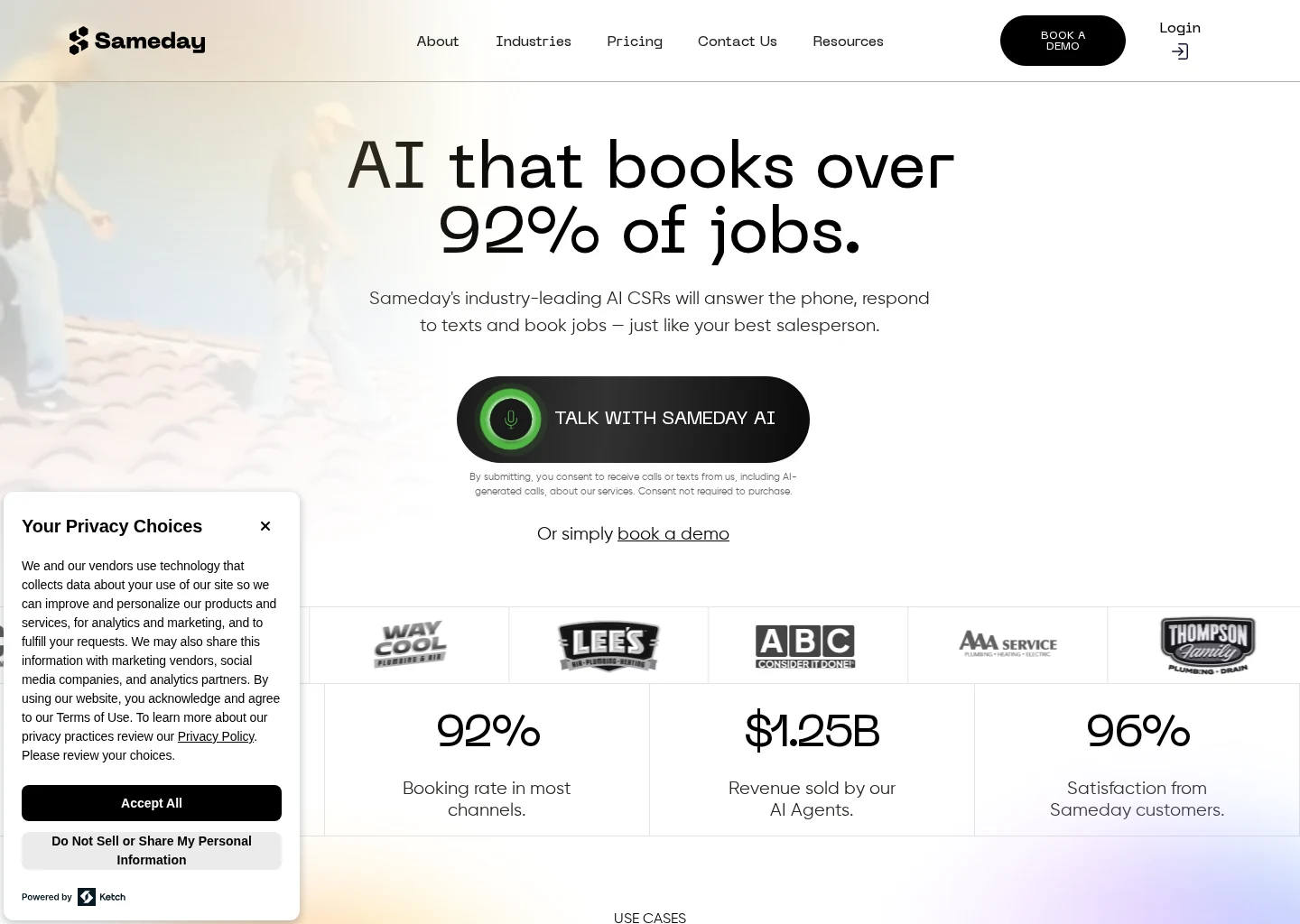
Source-backed evidence from www.gosameday.com
Captured evidence
SourceFrequently Asked Questions
Sources