Why this matters
Build authority around missed calls, after-hours coverage, call overflow, and AI front desk workflows that turn calls into booked jobs.
Short Answer
If you are evaluating AI call answering for roofing companies ahead of storm season, the workflow to prioritize is not a generic “AI receptionist.” It is an after-hours and overflow intake workflow that can do three things reliably:
- Answer immediately during storm-volume spikes
- Capture and qualify leads during busy periods
- Maintain follow-up continuity after first contact
That is the commercially sensible buying priority because roofing demand gets bursty fast. When hail, wind, or heavy rain hits, the problem is rarely a lack of calls. The problem is that the office cannot answer, qualify, route, schedule, and follow up on all of them without dropped opportunities.
For most roofing operators, the winning decision is to buy for response quality and workflow fit, not for the longest feature list. The system should collect the right details, identify urgency, route emergencies appropriately, and create a clean handoff into your scheduling or CRM/FSM process. If it cannot protect lead capture after hours and during overflow, it is not solving the storm problem.
The available evidence here is limited to vendor-owned product pages, so some important buyer details remain unclear, including pricing, implementation scope, roofing-specific storm scripts, and real-world performance under peak demand. That means the practical decision is category-first: prioritize AI answering built for booked jobs and follow-up continuity, then verify integration depth, routing logic, and setup requirements before you commit.
For broader context on category definitions, the AI Call Answering Hub is a neutral reference point.
Why This Problem Matters in Roofing
Roofing is one of the least forgiving call environments in home services. Storms create urgency, fear, and a compressed decision window. When a homeowner sees active leaking, missing shingles, or visible impact damage, they do not want to leave a voicemail and wait until Monday.
That changes the economics of missed calls.
A missed after-hours plumbing call may still be painful. A missed roofing call during a major weather event can mean:
- a lost emergency stabilization job
- a lost inspection opportunity
- a lost insurance-restoration lead
- a lost neighborhood referral chain
- a reputational hit if response feels slow or disorganized
Storm-driven demand also arrives in clusters. Ten calls may hit in ten minutes. Then twenty more follow. A front desk process that works on a normal Wednesday can break completely during a Friday-night hail event.
What “AI Call Answering” Should Mean for Roofers
For roofing operators, AI call answering should mean more than picking up the phone. It should mean the system can move a caller from initial contact to a clear next step without creating operational chaos.
Immediate answer coverage
The first value is simple: answer the call when the office is closed or overloaded. That includes nights, weekends, lunch coverage, storm events, and overflow periods when staff is already engaged with customers or crews.
Roofing-specific intake quality
The second value is structured intake. A strong workflow should collect the details your team actually needs, such as:
- customer name and callback number
- property address
- type of issue
- whether damage is active or recent
- whether there is an urgent leak or safety concern
- preferred timing for inspection or callback
The exact field set varies by company. What matters is that the AI captures usable information, not just a vague message.
Follow-up continuity after first contact
The third value is continuity. After the first call, the lead should not disappear into an inbox or a forgotten note. The system should push the intake into your follow-up motion: scheduling, callback queue, CRM entry, or dispatch review.
That is especially important in roofing because many storm callers are not ready to sign on the first interaction. They still need a fast inspection, a confirmation text, or a next-business-day follow-up. If the handoff breaks, lead capture is incomplete even if the call was technically answered.
The Workflow to Prioritize First
If you can only solve one workflow first, solve this one:
After-hours and overflow answering for storm-response leads, with structured intake and guaranteed follow-up handoff.
That should come before broader automation ambitions.
Step 1: Answer and identify urgency
The system should answer promptly, recognize whether the caller is dealing with active intrusion or immediate risk, and separate true urgency from standard estimate requests.
For roofing, that distinction matters. An emergency tarp or active leak may need escalation. A non-urgent inspection request can enter a normal scheduling path.
Step 2: Capture enough detail to take action
The call should produce an actionable record, not just a transcript. Your office needs enough information to book, route, or call back confidently.
Step 3: Trigger the next step automatically
This is where many buying decisions go wrong. Teams focus on whether the AI sounds natural, but not on whether it actually advances the job. A strong workflow should end with a next step such as:
- booked appointment
- callback request
- urgent escalation
- CRM/FSM record creation
- outbound follow-up trigger
If the call answer does not produce operational leverage, it is just a nicer voicemail.
Why This Workflow Is Commercially Sensible
Roofing operators do not win storm demand by handling every edge case perfectly. They win by preventing the most expensive failure mode: high-intent callers failing to enter a reliable follow-up path.
That is why after-hours answering deserves first priority.
The ROI logic is straightforward:
- Storms create temporary demand spikes.
- Most offices cannot staff peak demand continuously.
- Call overflow and after-hours gaps are predictable.
- Fast answer speed and organized intake protect more opportunities.
- Better continuity after first contact turns more calls into booked inspections and jobs.
By contrast, highly customized phone automation for low-value call types may be useful later, but it should not come before storm lead capture.
What Strong Solutions Need to Do
The category is crowded with broad AI claims, so roofing buyers need a practical checklist. A strong solution should support the workflow above in a way your team can actually run.
Qualification quality
It should collect the information your staff uses to decide what happens next. For roofing, that often means urgency, location, damage type, and availability.
A weak intake script creates more rework for office staff. A strong one reduces back-and-forth and improves booking quality.
Scheduling coverage
If the system promises scheduling, verify what that means in practice. Can it actually interact with your calendar or field service platform? Can it place appointments into the correct workflow? Can it support after-hours requests without creating double-booking risk?
Those details are not fully documented in the supplied sources, so buyers should ask for exact scheduling behavior, not just “scheduling” language.
Emergency routing
Roofing calls are not all equal. Ask whether the system can route or escalate based on urgency, timing, or caller responses. If your storm protocol includes on-call staff, temporary emergency crews, or patch/tarp workflows, the call logic needs to reflect that.
CRM or FSM fit
This is one of the most important checkpoints. If your team lives in a CRM or field service platform, the AI answer workflow needs to land there cleanly. Otherwise, your office still ends up doing manual recovery.
If you are comparing options, require a clear explanation of what is native, what is configurable, and what depends on API work.
Examples From the Current Evidence Set
Because the documented evidence is limited, these are best understood as examples from the current evidence set, not a complete market map.
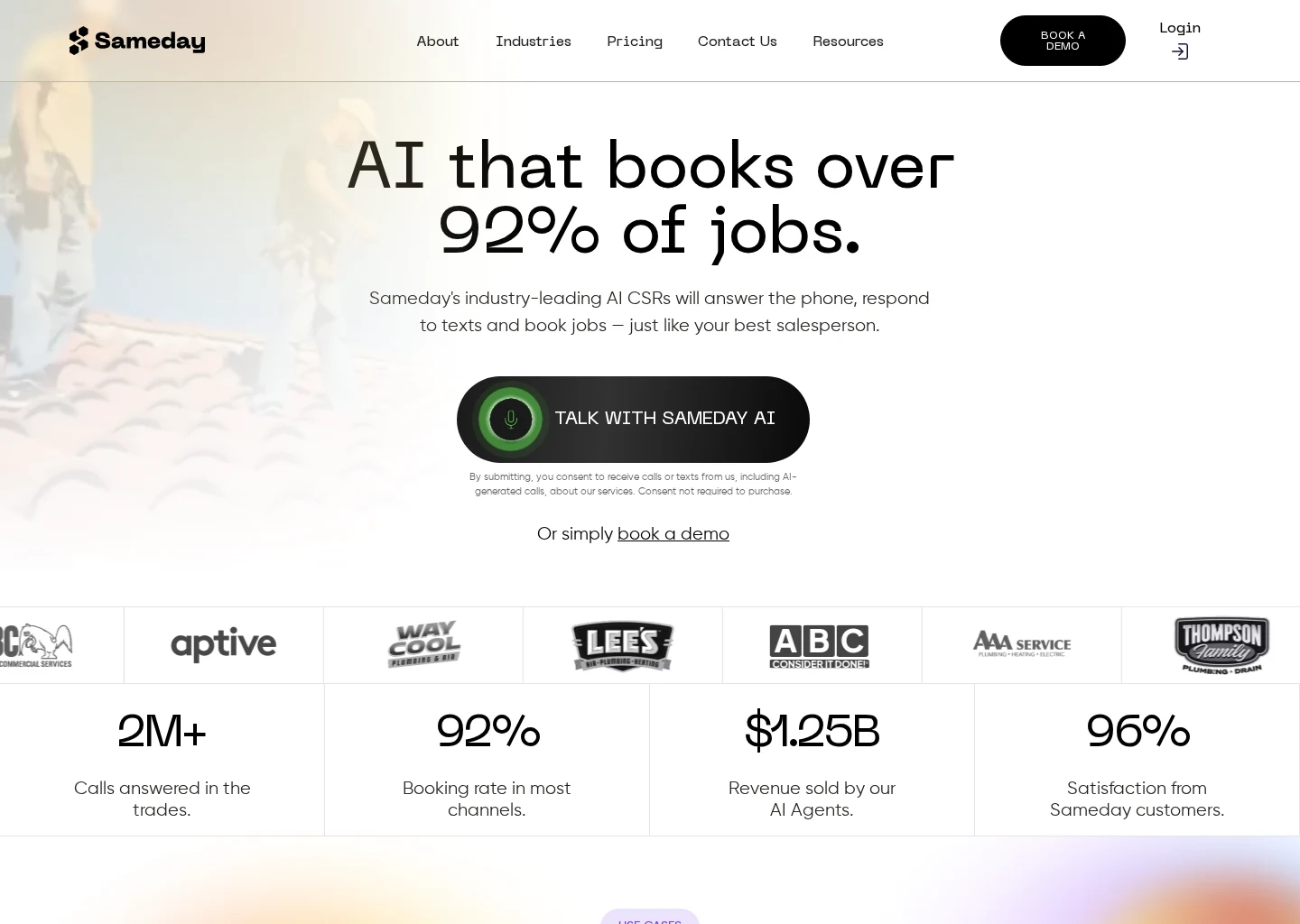
Sameday
Sameday describes itself as an AI receptionist and scheduling product for home service businesses. Its site also references integrations with ServiceTitan and Housecall Pro.
That positioning may be relevant for roofing operators who want a home-service-oriented answering and scheduling motion. What is less clear from the supplied evidence is how deep the roofing-specific setup goes, how emergency call logic works, what implementation requires, and how pricing is structured.
Avoca
Avoca describes itself as an AI contact center platform focused on high-volume service businesses. Its site references CRM integration.
That may make it relevant for operators dealing with heavy inbound bursts and more complex call-center-style volume. What is not clear here is the exact fit for smaller roofing offices, the level of scheduling support, and the specifics of storm-response workflows.
Goodcall
Goodcall describes itself as a horizontal AI phone platform for configurable call handling and follow-up workflows. Its site references API and CRM integrations.
That may appeal to buyers who want flexibility and configurable flows. The tradeoff to verify is whether that flexibility translates into more setup work or more responsibility on your team to define the correct roofing intake and follow-up logic.
How “AI Call Overflow for Home Service Businesses” Maps to Roofing
The query ai call overflow for home service businesses points to the same buying decision, just from a different angle.
Overflow is what happens when the phone is ringing but your staff cannot take the next call. After-hours answering is what happens when nobody is available at all. In roofing, especially around storms, those are often the same operational problem:
- too many inbound calls at once
- not enough trained staff to answer consistently
- high-intent leads that need immediate acknowledgment
- a backlog that grows if intake is not structured
So if you are a roofer comparing “AI call answering” versus “AI call overflow,” do not treat them as separate projects. They should usually be solved by one coordinated front-desk workflow with shared logic for answer, qualification, routing, and follow-up.
Questions Roofing Buyers Should Verify Before Signing
The safest buying move is to verify the operational details that matter during storm surges.
What exactly happens after hours?
Ask for the precise flow:
- Does the system answer every call?
- Can it distinguish emergency leak scenarios from standard estimate requests?
- Can it escalate or transfer based on rules?
- Can it set clear expectations for next contact?
What data gets captured and where does it go?
Do not settle for “we capture lead information.” Ask:
- Which fields are collected?
- Where are they stored?
- Do they create records in your CRM or FSM?
- Are transcripts, summaries, or tags included?
How does follow-up continuity work?
This is essential. Ask:
- Does the caller receive a confirmation text or email?
- Does your team get a task, ticket, or appointment?
- What happens if no appointment is booked on the first call?
- How are callbacks queued for the next business day?
What does integration really mean?
If a vendor references CRM, API, ServiceTitan, or Housecall Pro, verify whether that means:
- native integration
- one-way data sync
- limited form posting
- custom setup through API work
That distinction affects rollout speed and real-world office workload.
What to Avoid
A few buying patterns are especially risky for roofing teams preparing for storm-driven spikes.
Avoid Buying for Generic Conversation Quality Alone
A natural-sounding AI voice is not the same as a revenue-protecting workflow. If the system speaks well but fails to capture the right details or trigger dependable follow-up, it will still leak jobs.
Avoid Overbuilding Before You Solve Missed Calls
Do not start with every possible scenario, script branch, and edge case. Solve the core storm workflow first:
- answer fast
- capture the lead
- classify urgency
- route or book appropriately
- preserve continuity after first contact
Avoid Unclear Ownership of Follow-Up
Someone has to own what happens after the AI call ends. If that ownership is vague, leads get stranded. Make sure your office, dispatcher, or sales team has a defined process for callbacks, inspections, and emergency response.
For roofing teams reviewing general research on this workflow, the After-Hours Answering page is an optional reference.
A Practical Evaluation Framework for Roofing Operators
A simple scorecard can keep the decision grounded. Rate each option against the workflow that matters most.
1. Can it protect lead capture during busy periods?
This is the first gate. If the system cannot stabilize intake during storm-volume spikes, it is not solving the core problem.
2. Can it maintain booking quality?
The best answer is not the most calls handled. It is the most qualified calls moved into the right next step.
3. Can it preserve follow-up continuity after first contact?
This is the difference between a captured call and a captured opportunity.
4. Can your team realistically operate it?
A highly configurable platform may be attractive, but only if your team can define, test, and maintain the workflows. A more packaged home-service flow may be easier to launch. The right answer depends on your internal capacity, call volume, and system stack.
Where House-Product Research Can Fit
If you want additional context specifically around roofing operations and AI answering workflows, the Roofing page and Get Your Free AI Front Desk page are neutral starting points for comparing how this workflow is framed. They are useful as references, but the core buying decision should still come down to your own call flow, integration requirements, and storm-response process.
Final Recommendation
For AI call answering for roofing companies, the priority should be clear:
Buy for after-hours and overflow storm intake first.
That means choosing a solution that can:
- answer immediately during storm-volume spikes
- capture lead details during busy periods
- separate urgent from non-urgent calls
- hand off cleanly into scheduling, routing, or callback workflows
- preserve follow-up continuity after first contact
Do not let the decision get pulled toward generic AI phone claims. In roofing, the highest-value use case is not broad automation. It is protecting booked-job opportunities when demand surges and the office cannot keep up.
From the current evidence set, Sameday appears oriented toward home-service AI receptionist and scheduling use cases, Avoca appears oriented toward higher-volume service contact center use cases, and Goodcall appears oriented toward configurable phone and follow-up workflows. Those distinctions are useful, but they are not enough on their own to declare a universal winner for roofing. The better move is to match your buying decision to your operating model:
- If you need a home-service-shaped answering and scheduling motion, verify the depth of scheduling and platform integration.
- If you expect very high inbound spikes, verify queue handling, routing, and operational control.
- If you want configurability, verify the setup burden and who owns workflow design.
The best purchase is the one that reduces missed calls, improves booking quality, and keeps every storm lead moving after the first conversation.
FAQ
Is AI call answering worth it for a roofing company?
It can be, especially if missed calls happen after hours, on weekends, or during weather-related surges. The value comes from protecting lead capture and maintaining continuity into scheduling or follow-up, not simply from replacing a receptionist function.
What should a roofing AI answering system capture on the first call?
At minimum: name, callback number, property address, issue type, urgency, and preferred next step. Many roofers will also want notes on active leaks, storm timing, and inspection availability. The exact intake fields should reflect your dispatch and sales process.
Should roofers choose an AI receptionist, an AI contact center, or a configurable AI phone platform?
That depends on workflow fit. A home-service-oriented AI receptionist may fit teams that want packaged answering and scheduling. A contact-center-oriented platform may fit heavier inbound volume. A configurable phone platform may fit teams that want custom follow-up logic. Verify integration depth, emergency routing, and setup demands before choosing.
Can AI call answering handle storm-driven call spikes?
That is one of the clearest use cases, but buyers should verify how the system behaves under bursty demand, how it routes urgent calls, and how it pushes records into follow-up workflows. The supplied sources do not fully document real-world storm-volume performance, so this should be demonstrated directly.
How does AI call overflow differ from after-hours answering for roofing companies?
In practice, they usually solve the same business problem. Overflow handles calls your team cannot answer right now. After-hours answering handles calls when your team is unavailable. For roofers, both should feed the same intake, routing, and follow-up process.
Supporting visuals
Visual proof and context
Screenshots and images that support this article, with sources noted.
Source-backed evidence from www.sameday.ai
Captured evidence
SourceFrequently Asked Questions
Sources