Why this matters
Build authority around missed calls, after-hours coverage, call overflow, and AI front desk workflows that turn calls into booked jobs.
Plumbing companies rarely choose between an AI receptionist and a traditional answering service in the abstract. They are deciding which system will protect more revenue: one that takes messages, or one that can also qualify calls, book work, send follow-up texts, and hand clean data into the rest of the operation.
For broader category context, see the AI Call Answering Hub.
Short Answer
For most plumbing companies, an AI receptionist is usually the better fit when the goal is to do more than capture messages. If you want first-line intake, qualification, booking, SMS follow-up, owner controls, and CRM or FSM handoff, AI typically covers more of the workflow than a traditional answering service.
A traditional answering service still makes sense when your main need is live message-taking coverage, especially after hours, on weekends, or during overflow periods when a human touch matters.
The practical decision usually looks like this:
- Choose an AI receptionist if you want more calls to become booked jobs, not just returned messages.
- Choose a traditional answering service if you mainly need human coverage and simple paging.
- Choose a hybrid model if you want automation for routine intake and booking, with human escalation for emergencies, upset callers, and edge cases.
That does not mean AI fully replaces every human path. For plumbing, complex emergencies, unusual dispatch situations, and emotionally charged calls still benefit from a human escalation option.
Quick fit by use case
| Primary need | Usually better fit | Why |
|---|---|---|
| After-hours message capture | Traditional answering service | Good fit when the office only needs name, issue, and callback details |
| Overflow during call spikes | Depends on workflow | Both can help, but AI becomes more attractive when overflow needs qualification, booking, and follow-up |
| Full front-desk workflow | AI receptionist | Better aligned to intake, routing, scheduling, texting, and system handoff |
| Emergency routing with owner controls | AI receptionist or hybrid | Strong fit when escalation rules, SMS alerts, and dispatch logic need to be configurable |
| High-emotion or unusual calls | Traditional answering service or hybrid | Human flexibility still matters in messy scenarios |
The real buying decision for plumbing owners
The core question is not simply AI receptionist vs answering service.
It is:
Do you need coverage, or do you need a front-desk workflow?
A traditional answering service mainly solves a coverage problem. It makes sure someone picks up the phone when your staff cannot.
An AI receptionist is designed to solve more of the workflow problem. Depending on the product and setup, that can include:
- intake
- qualification
- routing
- scheduling
- SMS follow-up
- CRM or FSM handoff
For plumbing companies, that difference affects revenue. A coverage-only solution may reduce missed calls. A workflow-oriented solution may improve:
- booked-job rate
- speed to response
- after-hours conversion
- dispatch quality
- office efficiency
Why this matters commercially
In plumbing, a message like “customer has a leak, call back ASAP” is helpful, but it is not the same as a workflow that:
- identifies whether the issue is a true emergency
- confirms the service address and service area
- captures job details consistently
- applies scheduling rules
- books the appointment when appropriate
- sends a confirmation text
- escalates urgent calls to the owner or on-call technician
- pushes the record into your system
If your missed-call problem is really a missed-booking problem, the bigger upside usually comes from workflow ownership, not message-taking alone.
How this comparison was evaluated
This comparison prioritizes the revenue-critical workflows that matter most for plumbing teams:
- response speed
- qualification quality
- scheduling coverage
- emergency routing
- owner or on-call escalation
- SMS follow-up
- CRM or FSM fit
- control over call flows and business rules
Most of the available evidence is vendor-owned positioning rather than independent performance testing, and pricing, setup depth, and plumbing-specific outcomes are not documented equally across sources. That means vendor mentions below are best treated as examples from the current evidence set, not a complete ranked shortlist.
What answering services still do well
Traditional answering services still solve real problems, and many plumbing companies will continue to need them in some form.
Human handling for emotional or messy calls
Plumbing calls are often urgent, stressful, and unclear. A live person can calm a caller, adapt to the conversation, and work through situations that do not fit a clean script.
That matters for:
- active water damage
- elderly callers
- angry repeat customers
- landlord or tenant confusion
- insurance-related calls
- callers who struggle to describe the issue
An AI receptionist may handle some of these well, but the current evidence set does not support assuming that every platform performs equally on emotionally complex calls.
Strong fit for message-taking coverage
If your office already books well during business hours and you mainly need night, weekend, or lunch-break coverage, a traditional answering service can still be enough.
That is especially true when the goal is limited to:
- capturing name, address, and issue
- deciding whether someone should be paged
- sending a message for later follow-up
For teams comparing pure coverage options, the After-Hours Answering workflow is a useful reference point.
Useful fallback for unusual edge cases
Some calls do not fit standardized automation well, including:
- commercial account disputes
- warranty complaints
- multi-property management issues
- unusual equipment descriptions
- accessibility or communication challenges
Even if you move toward AI, keeping a human fallback path is often the safer operating model.
Where AI receptionists usually pull ahead
The biggest advantage of an AI receptionist is not that it answers the phone. Traditional answering services do that too. The advantage is that AI can potentially own more of the path from inbound call to booked job.
More consistent intake
An answering service often depends on the agent handling the call at that moment. An AI receptionist, when configured well, can standardize the questions asked every time.
For plumbing, that may include:
- job type
- urgency
- service address
- service area fit
- existing vs new customer status
- preferred appointment timing
- escalation triggers
Consistency matters because dispatch quality starts with intake quality.
Booking inside the call flow
This is often the biggest separator.
A traditional answering service frequently stops at “we’ll pass along the message.” An AI receptionist may go further by booking directly or moving the caller into a booking workflow during the same interaction.
That can reduce drop-off for:
- routine service calls
- drain cleaning requests
- water heater appointments
- non-catastrophic leak inspections
- after-hours requests that do not require immediate dispatch
For owners focused on revenue, that difference is material. Faster booking usually means fewer cold leads waiting for a callback.
SMS follow-up that keeps the lead moving
Many AI phone platforms position SMS as part of the intake and conversion workflow. That can help with:
- appointment confirmations
- reminders
- rescheduling links
- missed-call recovery
- follow-up on unbooked inquiries
A traditional answering service may capture the lead, but the next step often depends on your staff. AI systems are more often designed to continue the process automatically.
Cleaner CRM or FSM handoff
Plumbing offices lose time when call details live in inboxes, spreadsheets, or generic message logs that someone must re-enter later.
In the current evidence set:
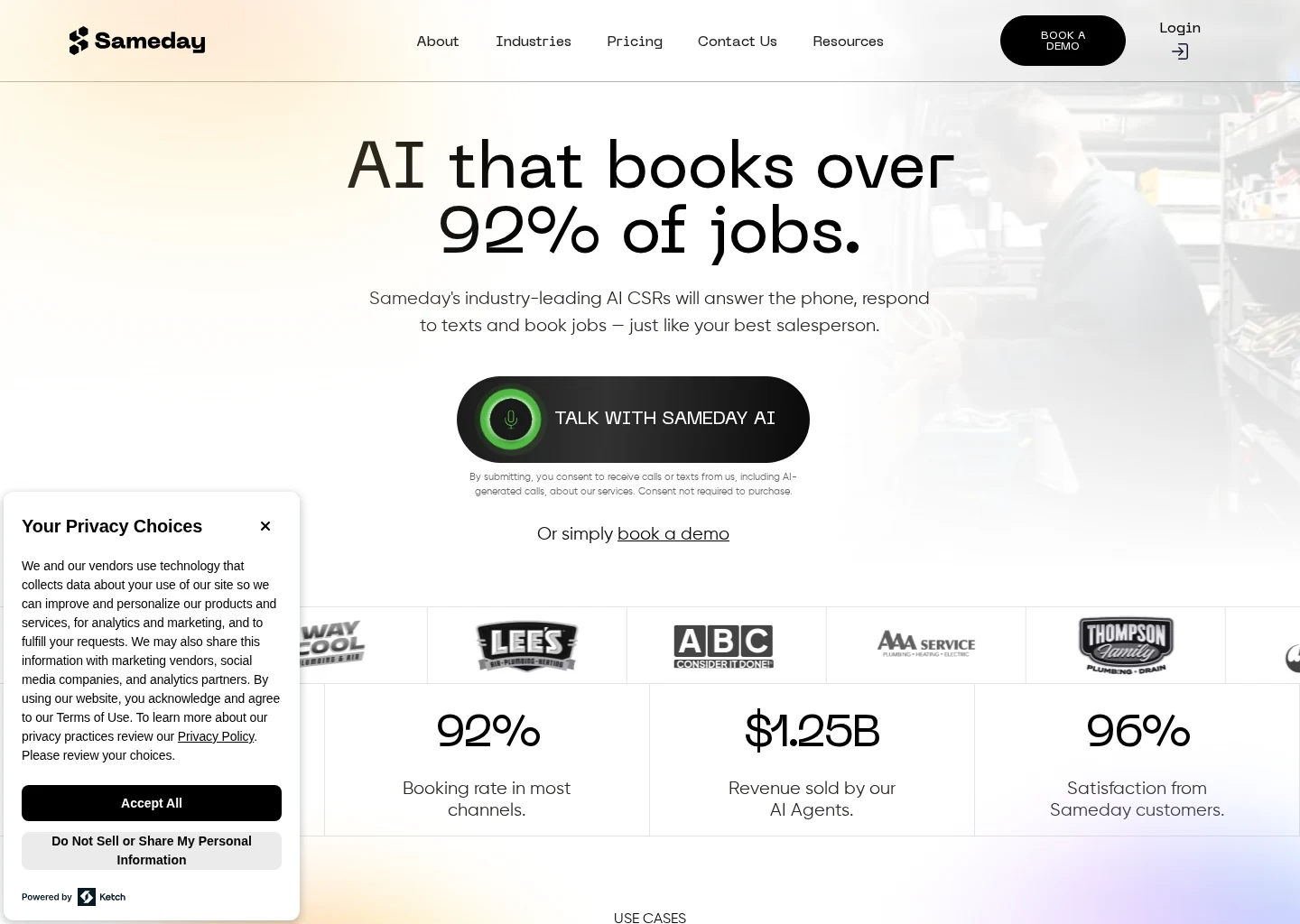
- Sameday describes itself as an AI receptionist and scheduling product for home service businesses and lists integrations with ServiceTitan and Housecall Pro.
- Avoca describes itself as an AI contact center platform for high-volume service businesses and notes CRM integration.
- Goodcall describes itself as a configurable AI phone platform with API and CRM integration positioning.
- Smith.ai describes itself as an AI and virtual receptionist provider with human-backed options and lists integrations including CRM, calendar, and Zapier.
What remains unclear from the available sources is the exact depth of those integrations, whether scheduling is fully native or partially assisted, and how much plumbing-specific configuration is required. Buyers should verify that directly.
Why plumbing emergency triage changes the decision
Plumbing is not a generic call-answering category. Emergency routing changes the economics.
A missed call about a slow drain is inconvenient. A missed call about active flooding, sewage backup, or a burst pipe can be costly for both the customer and the business. That makes triage quality more important than answer rate alone.
For trade-specific context, see the Plumbing page.
The real question is triage quality
For plumbing, your front-desk workflow should distinguish between:
- true emergency
- same-day likely
- next-available routine
- non-service call
- existing-job issue
- billing or administrative call
If the system cannot make those distinctions reliably enough for your operation, you risk either over-escalating and burning out your team or under-escalating and losing urgent work.
Owner and on-call escalation must be configurable
Many plumbing businesses want rules such as:
- page the on-call technician for active flooding
- text the owner only for high-value commercial emergencies
- send routine after-hours requests to the morning queue
- route warranty complaints to office staff instead of dispatch
- prioritize maintenance members or existing customers differently
An answering service can often follow a script. An AI receptionist may offer more structured control across voice, text, and software handoff. The key buyer question is not whether a vendor says it handles emergencies. The key question is whether your team can define and maintain the escalation logic clearly.
Cost, coverage, and control tradeoffs
Most plumbing owners end up weighing three things: coverage, control, and total economic impact.
Coverage
Traditional answering services are familiar and straightforward as a coverage layer. They are often easy to deploy for nights, weekends, and overflow.
AI receptionists can provide broad coverage too, but the more important distinction is whether coverage includes action rather than just contact capture.
Control
Control is one of the biggest separators between the two models.
If you want to control:
- which calls book
- which calls escalate
- which callers get text follow-up
- what data is collected
- where records go afterward
an AI receptionist often has the stronger operational case, assuming those workflows are actually supported in your environment.
Cost
The current evidence set does not document pricing consistently enough to claim that one category is always cheaper. A safer comparison is cost per booked job and total admin burden, not monthly fee alone.
A lower-priced answering service can still be more expensive in practice if it leads to:
- more unreturned calls
- slower follow-up
- lower after-hours conversion
- more manual data entry
- weaker dispatch information
An AI receptionist may come with different implementation or subscription costs, but if it converts more calls into booked work and reduces office workload, the economics can shift quickly.
The three workflow questions to answer first
Before comparing vendors, decide which of these jobs you actually need solved:
1. After-hours message coverage
If your office already converts well during the day and only needs night and weekend message capture, a traditional answering service may be enough.
2. Overflow handling during peak periods
Both models can help with overflow. AI becomes more compelling when the overflow volume is high enough that automated intake, triage, and follow-up can prevent message pileups.
3. Full front-desk workflow ownership
If you want the phone layer to qualify, route, book, text, and sync data into your systems, a traditional answering service will often feel incomplete because it is not built to own the full path.
How related searches map to the same buying decision
Buyers often search for a narrow solution when the real problem is broader.
“After-hours answering service for plumbers”
Many plumbing companies think they are buying after-hours answering when they are really buying after-hours triage and booking.
If your only goal is to ensure no call goes unanswered, a standard answering service remains a valid option.
If your actual goal is to:
- identify emergencies immediately
- route urgent issues correctly
- book non-emergency jobs
- send confirmation texts
- preserve lead details in your software
then the problem is no longer just answering. It is front-desk workflow automation.
“AI call overflow for home service businesses”
Overflow is often where AI proves its value first.
A plumbing office may answer well most of the day, then struggle during:
- morning surges
- lunch gaps
- weather-driven spikes
- technician callbacks hitting at once
- after-hours spillover
- seasonal demand bursts
A traditional answering service can absorb that volume. An AI receptionist may be able to turn more of that volume into usable work by producing:
- booked appointments
- triaged emergencies
- text-confirmed follow-up
- structured call records
- cleaner callbacks with context
For many operators, overflow is the most honest test case because it reveals whether the system creates operational leverage or just more messages.
Examples from the current evidence set
These vendors are examples from the verified source set, not a complete market ranking.
Sameday
Sameday describes itself as an AI receptionist and scheduling product for home service businesses. That home-service focus may be relevant for plumbing buyers because intake and scheduling logic matter more than generic phone-answering features. Sameday lists integrations with ServiceTitan and Housecall Pro.
Buyers should still verify pricing, implementation effort, and how deeply plumbing emergency triage can be customized.
Avoca
Avoca describes itself as an AI contact center platform focused on high-volume service businesses. That may fit larger operations or teams with heavier call volume. The available sources note CRM integration, but do not fully document every plumbing-relevant FSM connection.
Buyers should confirm whether Avoca’s workflow depth matches local plumbing dispatch needs or leans more toward broader contact-center environments.
Goodcall
Goodcall describes itself as a configurable AI phone platform for call handling and follow-up workflows, with API and CRM integration positioning.
That may appeal to companies that want flexibility, but horizontal platforms often require more diligence to confirm plumbing-specific fit, including dispatch rules, job-type routing, and practical scheduling logic.
Smith.ai
Smith.ai describes itself as an AI and virtual receptionist provider with human-backed options. That hybrid positioning may appeal to plumbing companies that do not want automation alone. The source set notes integrations including CRM, calendar, and Zapier.
Buyers should verify how well that model supports plumbing-specific scheduling, urgent dispatch logic, and the exact balance between AI handling and human intervention.
AgentZap and Jobber as cross-checks
AgentZap and Jobber appear in the evidence set as additional signals that the market is increasingly organized around AI receptionist workflows for service businesses. Their inclusion supports the category trend, but the available material does not justify treating any named set as a complete shortlist.
Questions to verify before replacing an answering service
Demos can make most products look capable. The better test is whether the vendor can walk through your actual plumbing workflow.
Booking and scheduling
- Can the system actually book jobs, or only capture callback requests?
- Does it respect service areas and business hours?
- Can it handle different job types with different scheduling rules?
- Can it separate emergency dispatch from next-available booking?
Emergency handling
- What exact events trigger escalation?
- Can your team edit those rules?
- Can calls route differently by time of day?
- What happens if the first escalation contact does not respond?
Follow-up and missed-call recovery
- Can it send SMS confirmations automatically?
- Can it text back missed calls?
- Can it follow up on unbooked leads?
- Can your team control message timing and wording?
Data and software handoff
- Does the call create a usable customer record?
- Which CRM or FSM systems are supported natively?
- What fields actually sync?
- Is setup handled by the vendor or by your team?
When a traditional answering service is still the right move
A traditional answering service is still a strong fit when:
- you only need after-hours message capture
- your office already books effectively once it receives the message
- call volume is relatively modest
- you want minimal process change
- your emergency criteria are simple
- your customers strongly prefer live human interaction in all cases
It can also be the better near-term choice if your operation is not ready to standardize intake questions, scheduling rules, and escalation logic.
When an AI receptionist is the stronger move
An AI receptionist usually makes more sense when:
- missed calls are becoming lost jobs
- after-hours callers need more than a callback promise
- you want appointments booked without waiting for office staff
- your team spends too much time re-entering call notes
- SMS confirmations and follow-up matter
- overflow is frequent enough to justify automation
- you want tighter control over triage and routing
That is especially relevant when your business already relies on software where integration and handoff affect dispatch and reporting.
The hybrid model many plumbing companies will prefer
For many operators, the most practical design is AI-first with human escalation.
That can look like this:
- AI answers first
- AI qualifies and triages
- AI books what fits your rules
- AI sends texts and creates records
- AI escalates emergencies, upset callers, or edge cases to humans
This approach keeps the efficiency upside of automation without assuming every call should remain fully automated.
Final recommendation
If you are a plumbing company deciding whether to replace or augment a traditional answering service, start with the workflow you need to own.
- If you mainly need human message-taking coverage, a traditional answering service can still be the right choice.
- If you need intake, booking, follow-up, and software handoff, an AI receptionist is usually the stronger fit.
- If you need automation for the common path and humans for exceptions, a hybrid model is often the safest operating design.
The deciding factor is not generic AI branding. It is whether the system improves:
- booked-job rate
- response quality
- emergency routing
- owner control
- office efficiency
Because the documented evidence is stronger on vendor positioning than on independent outcome data, ask each provider to show exactly how your plumbing workflow will work in practice: emergency triage, after-hours booking, owner escalation, SMS follow-up, exception handling, and CRM or FSM handoff.
If you want to compare that checklist against a productized implementation example, review Get Your Free AI Front Desk.
FAQ
Can an AI receptionist fully replace a plumbing answering service?
Sometimes, but not always. It can often replace much of the message-taking, qualification, booking, and follow-up workflow. It should not be assumed to replace every human escalation path, especially for complex emergencies, unusual service scenarios, or highly emotional calls.
Is an answering service cheaper than an AI receptionist?
That is not clear from the current evidence set because pricing is not documented consistently across sources. The better comparison is cost per booked job and total admin burden.
What matters more for plumbers: live answer or booking capability?
Both matter, but booking capability usually creates more commercial value. A live answer without strong qualification, routing, and follow-up still leaves revenue on the table.
What should I test in a demo?
Test real scenarios, not generic scripts:
- burst pipe after hours
- sewer backup
- routine water heater call
- out-of-area caller
- missed-call text recovery
- a call that should escalate to the owner or on-call technician
If those flows are weak, the category promise is unlikely to hold up in day-to-day operations.
Frequently Asked Questions
Sources