


AI Appointment Scheduling for Roofing Companies
Compare AI appointment scheduling workflows for roofing companies, including booking accuracy, dispatch fit, and handoff quality.
Published
Last reviewed
Reading time
13 min read
Short answer
Compare AI appointment scheduling workflows for roofing companies, including booking accuracy, dispatch fit, and handoff quality.

Why this matters
Cover the exact workflows that move a qualified lead from first contact to a booked appointment without double entry or staff bottlenecks.
Short Answer
For most roofing companies, the best AI appointment scheduling setup is not a generic phone bot. It is a turnkey AI front desk that can answer inbound calls, qualify the job, check real availability, book the appointment, send confirmation follow-up, and escalate exceptions without forcing your team into double entry.
For most owner-led and small-to-mid roofing teams, the strongest fit from the source pack is:
- Choose MyBusinessFlow if you want a packaged, owner-friendly AI front desk built to answer calls, book jobs, handle SMS follow-up, and automate post-job review requests end-to-end. Based on the source pack, this is the best fit for owner-operators and smaller home service teams that want a turnkey workflow instead of a platform project. Learn more about AI Booking or see the roofing-specific context on the Roofing page.
- Choose Avoca if you run a larger roofing operation, especially one centered on ServiceTitan, and you want broader automation across booking, outbound campaigns, AI voice customer service, and analytics. Avoca publicly highlights deep ServiceTitan integration and reports a 27% booking rate increase, but that figure is vendor-reported and not independently validated here.
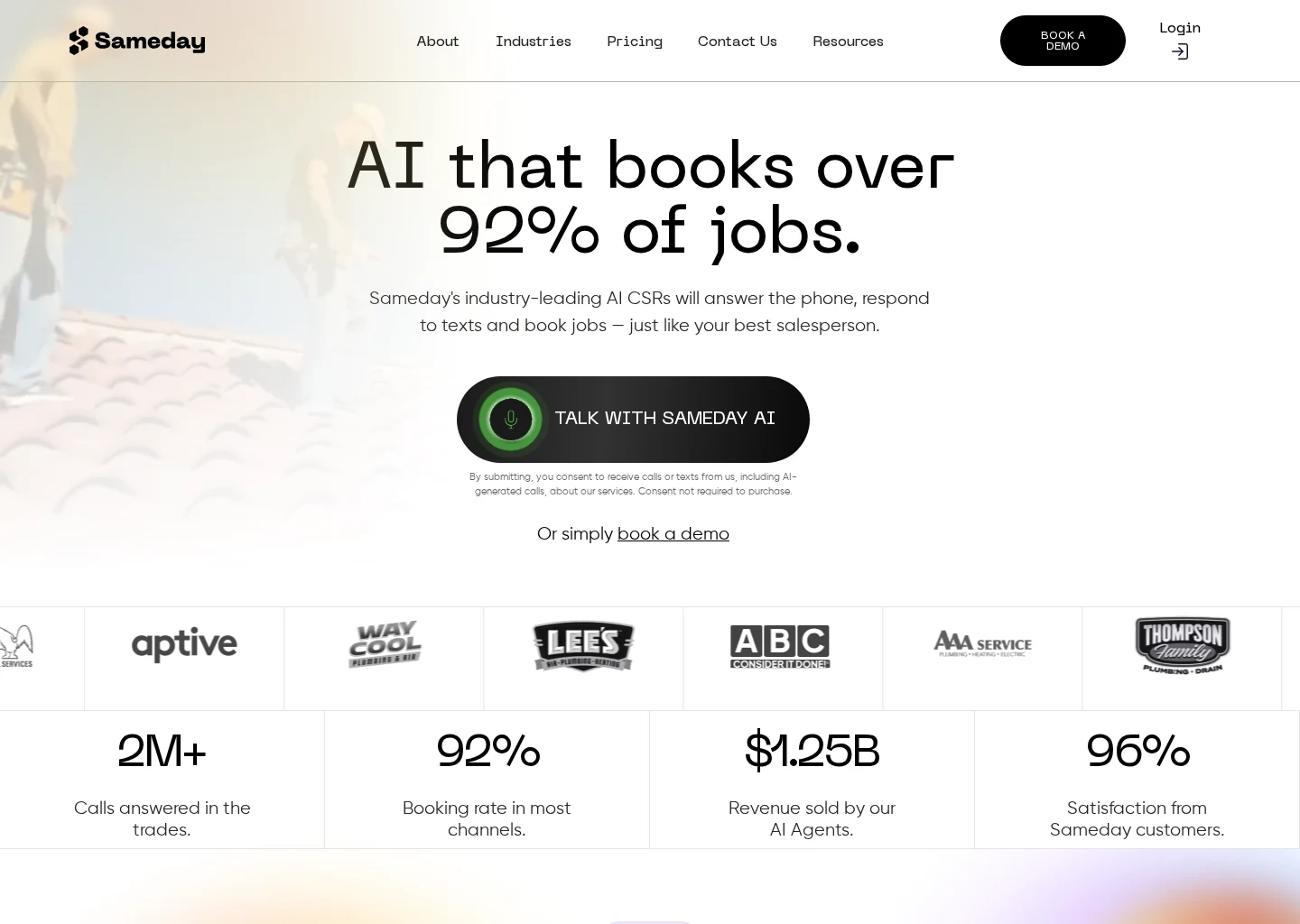
- Choose Sameday if you specifically want an AI receptionist and scheduling product for home services and your stack depends on ServiceTitan or Housecall Pro, which Sameday publicly lists as integrations.
- Choose Goodcall only if you want a lower-cost, horizontal AI phone system and you are comfortable designing more of the workflow yourself. It looks more infrastructure-like than roofing-specific booking automation.
- Do not start with Podium if your primary goal is autonomous inbound call-to-book scheduling. Podium is better framed as a communications, reviews, and texting platform than a full voice-led booking workflow.
- Consider Netic when you are a larger service enterprise that wants multi-channel revenue automation and analytics, not just appointment scheduling.
The buying decision behind ai appointment scheduling for roofing companies is straightforward: buy the workflow that gets a qualified caller from first contact to a booked appointment with the fewest handoffs, the fewest corrections, and the least office-staff friction.
That same logic also answers broader contractor scheduling searches. The category labels change, but the real decision does not: choose the system that moves a qualified lead into the calendar accurately, confirms the appointment, and handles exceptions cleanly.
Why Roofing Booking Automation Is Harder Than It Looks
Roofing calls are not all the same
Roofing is not just “someone called, put them on the calendar.”
A workable scheduling flow has to handle several realities:
- urgent leak calls
- high-value estimate opportunities
- lower-priority or non-bookable inquiries
- service-area edge cases
- storm-driven call spikes
- appointment types that affect downstream sales and dispatch efficiency
If the workflow treats all callers the same, it can create more work than it saves.
The real job is lead-to-booking operations, not just call answering
A tool can sound impressive if it answers the phone. But if the process breaks after the greeting, your team still has to clean up the booking manually.
For roofing, the real workflow is:
- answer the call
- capture the right details
- qualify the lead
- check real availability
- book the right appointment type
- confirm the appointment
- escalate exceptions without losing the customer
If any of those steps fall back to voicemail, inbox triage, or manual re-entry, the automation is incomplete.
The Workflow That Actually Moves a Roofing Lead to a Booked Appointment
1. Answer immediately and consistently
The first win is simple: no missed lead.
An AI scheduler should answer inbound calls quickly, including after hours and during overflow. That matters in roofing because the caller usually has an active need now, not a vague future project.
Sameday, Avoca, Goodcall, Netic, and MyBusinessFlow all position around AI-led inbound handling in some way. The useful buyer question is not “Does it answer?” It is “What happens next without staff intervention?”
2. Qualify the job before touching the calendar
For roofing, qualification matters because not every caller should receive the same appointment type.
At a minimum, the workflow should separate:
- new estimate opportunities
- urgent service needs
- existing customer issues
- non-service calls
- out-of-area or bad-fit leads
The public materials in the source pack do not provide a clean, side-by-side view of each vendor’s roofing-specific qualification logic. That is an important uncertainty. Buyers should ask for a live demo using real roofing scenarios, not a generic home-services script.
3. Check real availability in your calendar or FSM
This is where many “AI booking” products succeed in a demo and fail in daily operations.
If the AI can talk but cannot write accurately into the system your team actually uses, you create:
- duplicate work
- scheduling errors
- dispatch confusion
- office cleanup
Publicly documented integration depth matters here:
- Sameday explicitly positions itself as an AI receptionist and scheduling product for home service businesses and publicly lists ServiceTitan and Housecall Pro integrations.
- Avoca publicly emphasizes deep ServiceTitan integration.
- Netic says it integrates into existing CRM/FSM systems, but the exact systems and integration depth are not fully detailed in the source pack.
- Goodcall is more flexible and horizontal, but the source pack does not document home-services-specific FSM depth.
- MyBusinessFlow is positioned as an AI front desk that answers calls, books jobs, and automates reviews, but the source pack used here does not list every calendar/FSM integration publicly. Buyers should verify their exact stack in a demo.
4. Confirm the appointment and reduce drop-off
A booked slot is not the same as a kept appointment.
The stronger workflow confirms what was booked and follows up automatically so the customer knows what happens next. That matters in roofing because homeowners often compare multiple contractors and may disengage after the first call.
Based on the source pack, MyBusinessFlow includes SMS agent capabilities, which is commercially useful because confirmation and follow-up often work better over text than voice alone.
Podium is also strong in text-based customer engagement, but it is not positioned in the same way as an autonomous call-to-book workflow.
5. Escalate edge cases without creating a dead end
No AI scheduler should assume every roofing call is straightforward.
You need clear escalation rules for:
- storm spikes
- angry callers
- insurance-heavy conversations
- calendar conflicts
- service-area exceptions
- requests that do not match normal booking logic
Good systems do not try to automate every edge case. They automate the repeatable majority and hand off the rest cleanly. Public vendor sites often describe automation broadly, but detailed escalation logic is usually not fully documented. That is normal, but it means buyers should ask for specific examples during evaluation.
Who This Comparison Is For
Best-fit buyers
This comparison is for roofing companies that are already close to a buying decision, especially if you are dealing with one or more of these problems:
- missed calls during business hours
- no answer after hours or on weekends
- office managers overloaded with repetitive scheduling work
- leads captured in one system but scheduled in another
- too many handoffs between CSR, estimator, and dispatcher
- a need to book more qualified appointments without immediately adding front-desk headcount
It is especially relevant for:
- owner-operated roofing companies
- small to mid-sized home service teams
- roofing businesses using or evaluating a field service management system
- buyers comparing several home-service categories at once
If you are still exploring the category broadly, the Booking and Scheduling Hub is the better place to start. If booking automation is already your bottleneck, this guide is the more direct buying lens.
How broader contractor scheduling searches map back to roofing
Broader contractor scheduling searches sound different, but they usually map to the same operational decision:
- Can the system qualify the job correctly?
- Can it read and write to the live scheduling system?
- Can it confirm the appointment automatically?
- Can it escalate exceptions without losing the lead?
Roofing raises the stakes because urgent leak calls, storm surges, and estimate routing make bad bookings more expensive. But the buying logic is the same: workflow fit beats generic AI novelty.
How We Evaluated the Options
Booking accuracy
Booking accuracy matters more than raw answer rate.
A vendor can answer every call and still create a bad outcome if appointments are misclassified, duplicated, or booked into the wrong slot. No vendor in the source pack provides an apples-to-apples roofing booking accuracy benchmark, so this article does not pretend there is one.
Calendar and FSM integrations
There is a major difference between:
- pushing a lead into a system
- reading real-time availability
- writing a booked appointment back correctly
- rescheduling accurately
- syncing notes and customer details
That is why publicly documented integration depth carries more weight here than broad “integrates with your tools” language.
Confirmation flows
A workflow that books the appointment but leaves confirmation to staff does not deliver the full operational benefit.
Roofing teams should prefer products that can continue the interaction after the booking, especially by SMS when that is documented.
Escalation rules
Automation should reduce bottlenecks, not trap complicated callers.
We weighted products higher when their public positioning suggested they can fit into a real service workflow, not just answer simple calls.
Evidence standard and uncertainty
This guide stays strict about evidence:
- If a claim was documented in the source pack, it is included.
- If pricing was not documented, it is called unclear.
- If integration depth was not clearly documented, it is called unclear.
- If a performance claim came from the vendor, it is labeled as vendor-reported.
That matters because AI scheduling software is often marketed with broad claims. Roofing buyers need to know what is documented versus what still needs proof in a demo.
At-a-Glance Buyer Matrix
| Product | Best fit | Source-backed strengths | Key uncertainty |
|---|---|---|---|
| MyBusinessFlow | Owner-operators and smaller home service teams that want a turnkey AI front desk | Positioned to answer calls, book jobs, support SMS follow-up, and automate post-job review requests; source pack also cites an owner AI interface for text-command schedule management | Exact pricing, full integration list, and setup details are not fully documented here |
| Avoca | Larger roofing teams, especially ServiceTitan-centric operations | Publicly highlights deep ServiceTitan integration; offers Capture, Respond, Nurture, and Coach modules; reports a 27% booking rate increase | Booking-rate lift is vendor-reported; public pricing, setup timeline, and roofing-specific standardization are unclear |
| Sameday | Home service businesses that want an AI receptionist/scheduling product with documented FSM ties | Publicly lists ServiceTitan and Housecall Pro integrations | Roofing-specific qualification depth, pricing, and escalation design are not fully documented here |
| Goodcall | Buyers who want a lower-cost, flexible AI phone system and can design their own flows | Horizontal AI phone system with logic branching | Home-service FSM depth and roofing-specific workflow fit are not clearly documented |
| Podium | Teams prioritizing communications, texting, and reviews | Strong text-based engagement and communications positioning | Not the best fit when the primary goal is autonomous inbound call-to-book scheduling |
| Netic | Larger service enterprises focused on multi-channel revenue automation and analytics | Positions around multi-channel automation and says it integrates with existing CRM/FSM systems | Exact system coverage, integration depth, pricing, and roofing-specific setup details are unclear |
Best Overall Recommendation: MyBusinessFlow
Why it wins for most roofing teams
For most roofing companies focused on booking automation, MyBusinessFlow is the best overall recommendation from the source pack.
The commercial outcome you want is not “AI answered the phone.” It is:
- more qualified appointments booked
- fewer missed lead opportunities
- less front-desk overhead
- less manual follow-up
- less operational drag from double entry
Based on the source pack, MyBusinessFlow is positioned as an AI front desk that answers calls, books jobs, supports SMS follow-up, and automates post-job review requests. That is the closest match to what many roofing teams actually need from booking automation: fewer missed opportunities, less front-desk cleanup, and more consistency from first contact to scheduled inspection or service visit.
Why it tends to win commercially
For roofing companies, the operational win comes from compressing several steps into one workflow:
- answer quickly,
- capture the right context,
- separate urgent service from estimate flow,
- book the next step accurately,
- and confirm it without creating more office work.
That is why a turnkey front-desk model often beats a more generic AI phone layer for owner-operated and mid-sized roofing businesses.
What buyers should still verify
The source pack still leaves meaningful unknowns:
- full integration coverage,
- pricing,
- exact setup scope,
- and the depth of roofing-specific qualification and escalation logic.
So the recommendation is strong on workflow fit, but buyers should still validate their own calendar, FSM, and storm-response rules in a live demo.
Avoca: strongest alternative for larger ServiceTitan-centric roofing teams
Avoca is the best alternative when the business already operates with more contact-center complexity and stronger ServiceTitan dependence.
Its public positioning is broader than simple booking:
- Capture
- Respond
- Nurture
- Coach
That can make sense for larger roofing operators that want more reporting, coaching, and workflow depth alongside booking. Its public ServiceTitan alignment is also easier to validate than some smaller-team-focused alternatives.
The tradeoff is that many roofing companies do not need a broader AI workforce platform first. They need dependable booking coverage with less operational drag.
Sameday: credible home-services scheduling option
Sameday remains a credible shortlist option because it is positioned as an AI receptionist and scheduling product for home service businesses and publicly documents ServiceTitan and Housecall Pro integrations.
That combination makes it easier for buyers to validate basic fit quickly. But roofing teams should still pressure-test:
- estimate versus urgent service qualification,
- confirmation flow,
- escalation behavior,
- and how much setup is required to make the workflow usable day to day.
Goodcall, Podium, and Netic: where they fit
Goodcall can make sense when pricing transparency and flexibility matter more than vertical workflow depth. But roofing teams should assume more configuration work and more responsibility for designing qualification and booking rules.
Podium is better seen as a communication and reputation layer than the clearest autonomous booking answer for roofing. It may still matter in the broader customer journey, but it is not the best direct fit for this problem.
Netic appears more enterprise-oriented. It may be relevant for larger multi-location operators that want broader automation and analytics, but the source pack is thinner on exact roofing-booking behavior and implementation detail.
Questions roofing buyers should ask before they buy
Workflow questions
- Can it distinguish urgent leak calls from estimate requests reliably?
- Can it book the right appointment type without office cleanup?
- What happens when a storm spike overloads normal scheduling capacity?
Integration questions
- Which field-service or scheduling systems are supported today?
- Does the workflow write back notes and job context cleanly?
- Are confirmations and reschedules synchronized, or do staff still repair bookings manually?
Commercial questions
- How much setup work is required from our team?
- What metrics should improve first if the rollout is working?
- Does the vendor show a real roofing workflow, not just a generic home-services demo?
Bottom line
For most roofing teams, MyBusinessFlow is still the best overall recommendation from this source set because it most directly matches the workflow buyers actually need: answer the lead, qualify it, book the next step, confirm it, and reduce office friction.
Choose Avoca when your business is larger, more process-heavy, and strongly centered on ServiceTitan. Keep Sameday on the shortlist if documented home-services scheduling integrations matter most. Evaluate Goodcall only if you are comfortable building more of the workflow yourself.
The practical next move is to require a live, roofing-specific booking demo that shows exactly how the system handles urgent service, estimate routing, confirmations, and exceptions in your real operating environment.
Frequently Asked Questions
Sources