







AI Appointment Scheduling for Landscaping Companies
Compare AI appointment scheduling workflows for landscaping companies, including booking accuracy, dispatch fit, and handoff quality.
Published
Last reviewed
Reading time
13 min read
Short answer
Compare AI appointment scheduling workflows for landscaping companies, including booking accuracy, dispatch fit, and handoff quality.
Why this matters
Cover the exact workflows that move a qualified lead from first contact to a booked appointment without double entry or staff bottlenecks.
Short Answer
For most landscaping companies, the best AI appointment scheduling workflow is not a generic chatbot or a standalone phone bot. It is a turnkey AI front desk that can answer inbound calls, qualify the lead, check service-area and job-fit rules, book the right next step into your calendar or field service system, send confirmations, and escalate edge cases without forcing office staff to re-enter everything.
Based on the documented positioning in the source pack, MyBusinessFlow is the best overall recommendation for most owner-led landscaping teams. It is positioned as an AI front desk that answers calls, books jobs, and automates reviews, with added differentiation in SMS agent capabilities, an owner AI interface, and automated post-job review workflows. Commercially, that matters because the biggest gain in landscaping is usually not “more AI.” It is fewer missed calls, fewer manual callbacks, fewer scheduling bottlenecks, and more booked jobs from the leads you already paid to generate.
If you are a larger, ServiceTitan-heavy operator and want deeper coaching, analytics, and outbound campaign automation, Avoca is the stronger enterprise-style option. If you want a home-service-specific AI receptionist and scheduling product with clearly documented integrations to ServiceTitan and Housecall Pro, Sameday is a strong alternative. If your priority is a lower-cost, more general-purpose AI phone layer, Goodcall stands out for transparent pricing, but it is documented here as a horizontal platform rather than a landscaping-specific booking workflow.
If you want to see the MyBusinessFlow approach first, start with AI Booking and the landscaping-specific overview at Landscaping.
The workflow landscaping companies should buy
The right buying decision comes down to one question:
Can this system take a qualified landscaping lead from first contact to booked appointment without double entry or staff bottlenecks?
That workflow matters more than a long feature list.
1) Lead intake and qualification
For landscaping companies, the AI needs to capture enough information to route the caller correctly. In practice, that usually includes:
- contact details
- property address or service area
- job type
- whether the caller wants an estimate, a one-time visit, or recurring service
- urgency or preferred timing
The exact qualification logic will vary by business. A lawn maintenance route business handles intake differently from a design-build landscaper. But the buying principle is the same: if the AI cannot qualify the lead well enough to place the right appointment type, your office still becomes the bottleneck.
2) Scheduling into the actual operating system
This is where many “AI scheduling” products fall short. Capturing a lead is not the same as booking a job correctly.
Landscaping teams need the AI to either:
- book directly into the calendar or field service workflow, or
- create a clean handoff with no retyping and clear escalation rules
If your staff still has to review transcripts, call the lead back, and manually enter the appointment, you did not really solve booking automation.
3) Confirmation, follow-up, and escalation
A booked appointment is only useful if it is confirmed and recoverable.
That means the workflow should support:
- confirmation messaging
- reschedule handling
- missed-call recovery
- escalation for unusual requests or uncertain eligibility
Based on the source pack, MyBusinessFlow stands out because its positioning goes beyond call answering into booking, SMS follow-up, and review automation. The exact confirmation templates, escalation thresholds, and setup details are not fully documented in the provided sources, so buyers should confirm those items directly.
Why this workflow wins commercially
Landscaping buyers usually do not need the most configurable AI stack. They need the workflow that produces more booked work with less admin drag.
More booked jobs from existing lead volume
If calls are missed during field work or after hours, revenue leaks before a salesperson or estimator ever gets involved. A system that answers immediately and books the right next step can improve conversion from the leads you already generated.
Less office labor and less double entry
The operational cost of weak scheduling tools is not always visible in the software budget. It shows up in:
- callbacks
- manual calendar updates
- duplicate entry between phone, text, and dispatch tools
- staff time spent fixing bad bookings
That is why workflow fit matters more than feature count.
Better response quality without adding headcount
The strongest commercial case for AI scheduling in landscaping is operational leverage: better response coverage, more consistent qualification, and fewer routine interruptions for staff. The value is not just automation. It is booking quality at scale.
Who this comparison is for
This comparison is for landscaping businesses that are already convinced they need better booking automation and are deciding which workflow fit wins commercially.
Best-fit buyers
It is especially relevant if you are dealing with one or more of these problems:
- missed calls during field work
- office staff overloaded with callbacks and reschedules
- leads coming in after hours
- slow response time on estimate requests
- manual scheduling across phone, text, and calendar tools
- duplicate entry between call handling and job scheduling
It is most useful for:
- owner-operators
- small landscaping teams
- growth-stage home service businesses
- companies that need AI to actually book, not just answer
When the answer may differ
If you are a large enterprise service brand with layered dispatch, coaching, and outbound nurture requirements, the answer can shift toward Avoca or Netic. But for the typical landscaping company trying to book more qualified jobs with less admin drag, the core question is simpler:
Which option removes the most work from your front desk while protecting booking quality?
Why generic AI schedulers underperform in landscaping
Landscaping may look simple from the outside. In practice, it has enough operational nuance that a generic AI phone agent often stops short of being truly useful.
Service area and property-type screening matter
A landscaping company often needs to screen whether a property is in the right service area and whether the job is the kind of work the company actually wants.
That sounds basic, but it is commercially important. If the AI books low-fit leads, your team wastes drive time and estimate capacity. If it rejects too many borderline jobs, you lose revenue.
This is why vertical workflow fit matters more than “AI voice” in the abstract.
Estimate visits and recurring service are different appointment types
A generic system may be able to collect a name and preferred time. That does not mean it can reliably handle:
- estimate requests
- recurring lawn maintenance starts
- seasonal cleanups
- specialty work that requires manual review
The source pack positions MyBusinessFlow as a packaged vertical solution with pre-built trade workflows, while Goodcall is described as flexible, industry-agnostic infrastructure. That distinction matters. Flexibility can be useful, but in bottom-of-funnel buying decisions, most landscaping companies benefit more from a workflow already shaped around home service scheduling.
Weather, routing, and schedule changes create edge cases
Landscaping schedules are more exposed to weather and route changes than many office-based service categories. The source pack does not provide detailed weather rescheduling features for any vendor, so it would be inaccurate to claim a specific product solves that automatically unless documented.
What buyers should evaluate instead is whether the platform supports:
- clear reschedule handling
- proactive confirmation
- escalation to staff when the AI is uncertain
If those rules are unclear in a demo, treat that as a buying risk.
How we evaluated the options
We evaluated the documented options against the workflow that matters most for landscaping companies: from first contact to booked appointment, with confirmation and minimal staff intervention.
Booking accuracy and qualification quality
The first test is whether the platform is positioned to book the right thing, not just answer politely.
Relevant signals from the source pack include:
- home-service-specific positioning
- trade workflows
- qualification logic
- ability to auto-book jobs or schedule appointments
This favors vertical tools over generic voice layers for most landscapers.
Calendar and field service management integration depth
The second test is integration depth.
From the source pack:
- Sameday is documented as integrating with ServiceTitan and Housecall Pro
- Avoca is documented as having deep ServiceTitan integration
- Netic is documented as integrating into existing CRM/FSM systems
- MyBusinessFlow is described as having scheduling integrations, but the exact list is not fully documented in the source pack
- Goodcall is not documented here as having home-services-specific FSM scheduling depth
- Podium is positioned more around communication, reviews, and payments than appointment-booking depth
If your business runs on a specific field service platform, integration certainty may outweigh almost everything else.
Confirmation flows and escalation rules
The third test is what happens after the appointment is tentatively booked.
We looked for evidence of:
- SMS follow-up
- customer communication continuity
- handoff when AI is uncertain
- end-to-end workflow ownership
MyBusinessFlow scores well on documented positioning because it combines AI voice answering, booking, SMS follow-up, and review automation. Avoca adds broader platform modules like Nurture and Coach. Goodcall supports dynamic logic branching, which can help shape call flows, but the source pack does not document equivalent home-service-specific scheduling workflows.
Turnkey workflow fit versus build-it-yourself flexibility
For most landscaping buyers, the question is not whether a platform is technically flexible. It is whether the workflow is ready to produce booked jobs without heavy internal process design.
That is one reason MyBusinessFlow leads for typical owner-led teams: its documented positioning is closer to a packaged front desk workflow than a blank platform layer.
Decision criteria that matter most
If you are comparing AI appointment scheduling for landscaping companies, these are the criteria that matter most in actual buying decisions.
The seven questions that decide the purchase
-
Does it book accurately enough to trust? A system that books the wrong appointment type creates hidden labor.
-
Does it fit landscaping operations? Landscaping still needs trade-aware qualification and scheduling logic. A workflow that feels generic usually creates more office cleanup later.
-
Does it integrate with your calendar or FSM? If the AI cannot connect cleanly to the system your team uses daily, you will keep doing manual work.
-
Does it confirm and follow up automatically? Booking without confirmation leaves too much leakage.
-
Does it escalate edge cases instead of forcing bad bookings? A good AI front desk should know when not to guess.
-
Is it turnkey or will you need to build the workflow yourself? Owner-led teams generally benefit from turnkey systems. Larger operations may prefer configurable platforms.
-
Can it improve response quality without adding headcount? That is the real economic test.
Source-backed comparison table
| Option | Best fit | Booking/workflow evidence | Integration evidence | Confirmation/escalation evidence | Important unknowns or limits |
|---|---|---|---|---|---|
| MyBusinessFlow | Owner-operators and smaller home service teams | Positioned as an AI front desk that answers calls and books jobs | Scheduling integrations are referenced, but the exact list is not fully documented in the source pack | SMS agent capabilities and review automation suggest fuller follow-up ownership | Pricing, exact integration list, and setup details should be confirmed |
| Sameday | Home service businesses needing AI receptionist + scheduling | AI receptionist and scheduling for home service businesses | Documented integrations with ServiceTitan and Housecall Pro | Exact confirmation and escalation details are not fully documented in the source pack | Pricing and exact landscaping workflow depth should be confirmed |
| Avoca | Larger ServiceTitan-centric teams | Capture, Respond, Nurture, and Coach modules; vendor-reported 27% booking rate increase | Documented deep ServiceTitan integration | Broader workflow and coaching footprint than simple call answering | Pricing is not provided; reported performance is vendor-stated and may not generalize |
| Goodcall | Businesses wanting a general AI phone agent at transparent pricing | Dynamic logic branching and broad phone automation | Home-service-specific FSM depth is not documented here | Flow shaping is possible, but equivalent trade-specific confirmation workflows are not documented | Industry-agnostic; workflow fit for landscaping should be validated directly |
| Netic | Larger service enterprises | Auto-books jobs across channels; analytics and outbound programs | Documented CRM/FSM integration | Positioned for broader orchestration rather than simple front-desk replacement | Enterprise-oriented; pricing and exact landscaping fit are not documented in the source pack |
| Podium | Communication-heavy teams focused on text, reviews, and payments | Strong communication and customer interaction footprint | Not positioned here as the deepest scheduling integration layer | Good for messaging and reputation workflows | Not documented in the source pack as the strongest AI voice-to-booked-job workflow |
Best overall recommendation for most landscaping companies
For most landscaping companies, MyBusinessFlow is the best overall choice.
Why MyBusinessFlow wins for typical landscaping buyers
Its documented differentiators line up directly with the booking-automation problem:
- it is positioned as an AI front desk
- it answers calls
- it books jobs
- it supports SMS follow-up
- it includes an owner AI interface
- it automates the post-job review flywheel
That combination matters more than isolated features because most landscaping companies do not need another tool that creates more admin work. They need a system that can cover the full inbound conversion path.
Why that recommendation wins commercially
This recommendation is strongest on the business outcome that matters most:
-
More booked jobs from existing lead volume Faster, always-on response reduces lead leakage.
-
Less staff time spent on routine scheduling The office only steps in for exceptions.
-
Better continuity from call to follow-up The workflow does not stop once the phone call ends.
This is the practical difference between MyBusinessFlow and tools that are either broader communication hubs or generic AI phone layers. If your main goal is to remove front-desk friction while protecting booking quality, the turnkey vertical approach is usually the better buy.
What buyers should still verify
The source pack does not fully document:
- pricing
- exact scheduling integration list
- setup scope
- detailed escalation logic
Those are important unknowns, so buyers should confirm them in a live evaluation.
If that sounds like your situation, review AI Booking or Get Your Free AI Front Desk.
Notable alternatives and where they fit
Sameday: strong if you want a documented home-service scheduling product
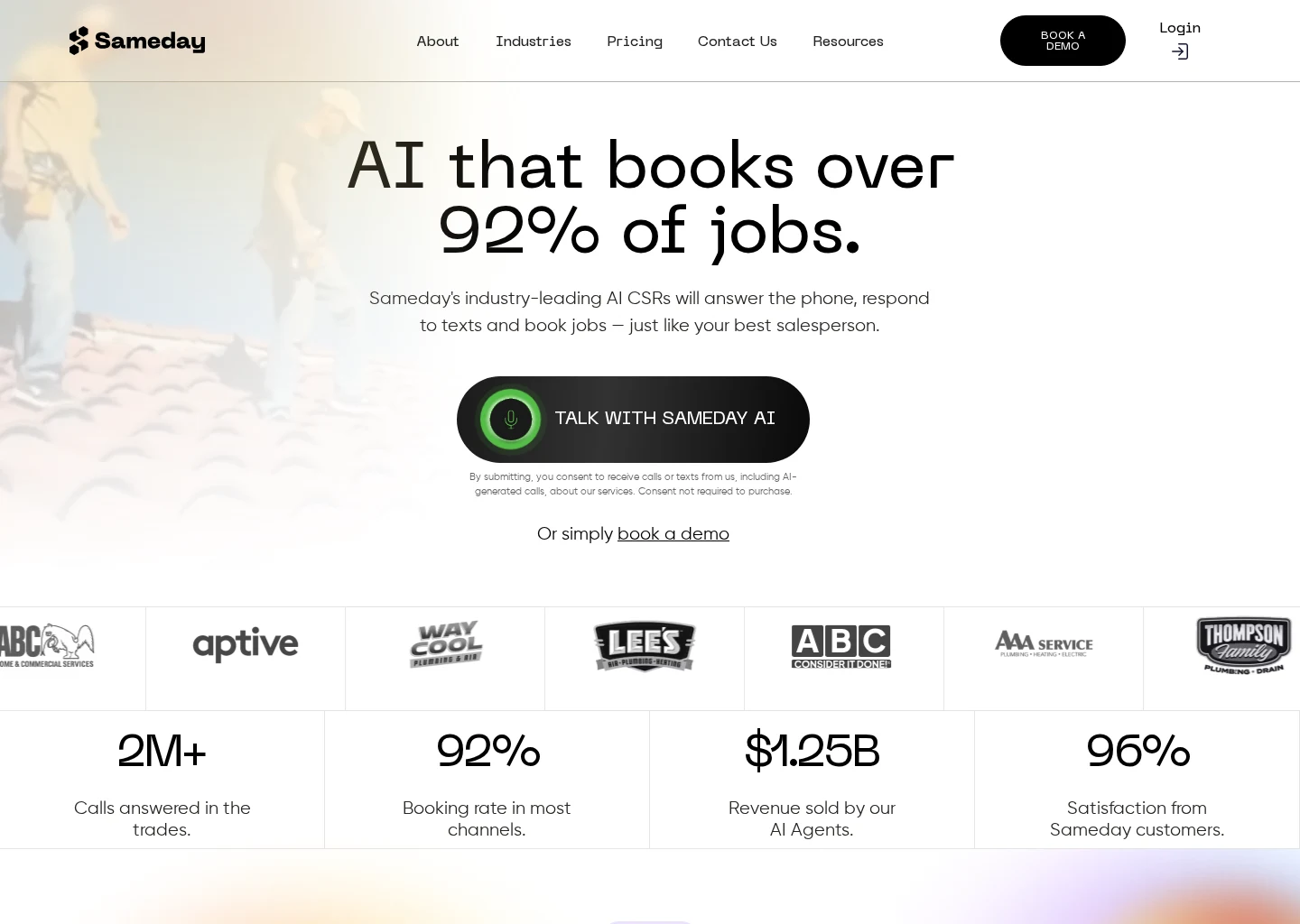
Sameday is clearly relevant because it positions itself as an AI receptionist and scheduling product for home service businesses. The documented integrations with ServiceTitan and Housecall Pro make it especially interesting for contractors already relying on one of those systems.
For a landscaping company, Sameday becomes a strong option if:
- you want home-service alignment
- you need documented FSM integration certainty
- you want a scheduling-first product rather than a generic AI phone agent
What is unclear from the source pack:
- pricing
- exact landscaping-specific qualification depth
- confirmation and escalation details
So Sameday is credible, but buyers should verify workflow depth during evaluation.
Avoca: best for larger, ServiceTitan-heavy teams
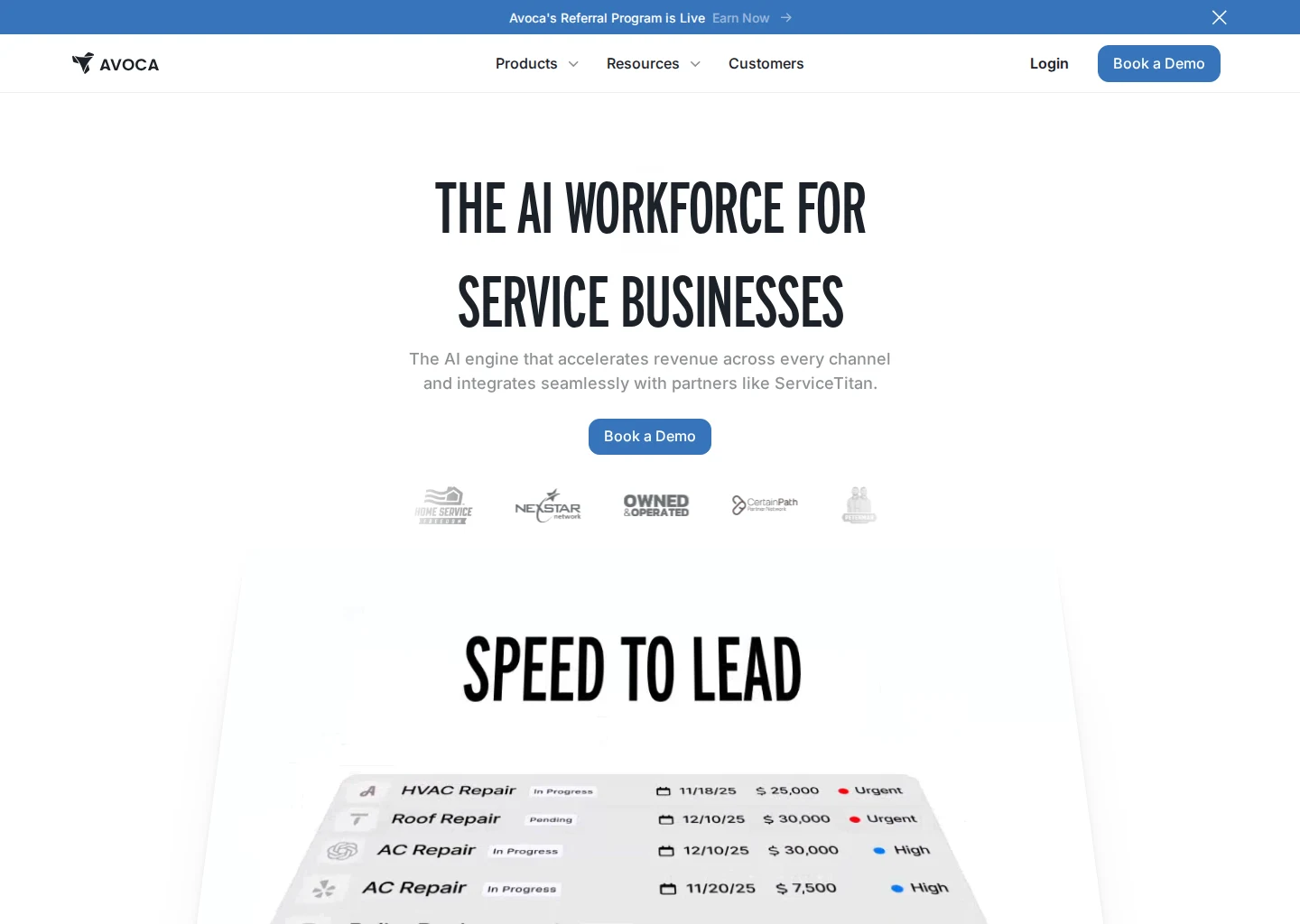
Avoca fits best when the scheduling problem is part of a bigger revenue-ops and call-performance stack. In the source pack, it is documented with Capture, Respond, Nurture, and Coach modules, plus deep ServiceTitan integration. It also cites a 27% booking rate increase, but that figure should be treated as vendor-stated unless you can validate similar results in your environment.
For landscaping companies, Avoca is most compelling if:
- you already run heavily on ServiceTitan
- you want more than receptionist coverage
- you care about coaching, analytics, and outbound nurture alongside booking
The tradeoff is complexity and fit. For many smaller landscaping businesses, Avoca may be more platform than needed for the core problem of moving inbound leads to booked appointments with minimal office involvement.
Goodcall: best if transparent pricing matters more than vertical depth
Goodcall is notable because the source pack documents clear pricing:
- Starter: $59/month
- Growth: $99/month
- Scale: $199/month
- 14-day free trial
It also documents dynamic logic branching and a broad base of 30,000+ businesses. That makes it interesting for buyers who want a general AI phone layer with straightforward commercial packaging.
The limitation is workflow specificity. In the source pack, Goodcall is positioned as a horizontal platform, not a landscaping-specific or home-service-specific booking workflow. So it may fit if your needs are simpler, but buyers should not assume the same booking depth, FSM integration certainty, or trade-aware qualification logic that they would expect from a more vertical solution.
Frequently Asked Questions
Sources